

Consumer lending software offers specialized platforms built for high-volume personal loan portfolios. The right system handles servicing complexity at scale, manages diverse payment structures with configurable payment waterfall logic, supports compliance requirements, and provides the reporting depth needed to run profitable consumer lending operations.
This guide compares the top 9 consumer lending software platforms for 2026, breaking down features, pricing, strengths, and limitations so you can find the platform that fits your servicing needs.
Key Takeaways:
- Servicing depth separates top platforms – the best consumer lending software excels at ongoing loan management, payment processing, delinquency workflows, and portfolio-level compliance rather than just application intake.
- Flexible loan structures reduce operational friction – support for variable schedules, rate adjustments, custom fees, and mid-loan changes prevents manual workarounds as your portfolio diversifies.
- Auditability reduces regulatory risk – built-in compliance safeguards, detailed audit trails, and accurate interest calculations become critical as loan volumes increase and scrutiny intensifies.
- Scalability determines long-term fit – platforms must maintain accuracy and performance as portfolios grow from hundreds to thousands of active accounts without data issues or system slowdowns.
Table of Contents
- Quick Comparison: Top Consumer Lending Software
- How We Evaluated These Consumer Lending Platforms
- 9 Best Consumer Lending Software Platforms in 2026
- How to Choose the Right Consumer Lending Software
- Frequently Asked Questions
- Find a Consumer Lending Platform That Scales With Your Portfolio
Quick Comparison: Top Consumer Lending Software
Here’s a quick overview of the best consumer lending software platforms for 2026 and what makes each one stand out.
| Platform | Best For | Includes Servicing? |
| Nortridge Loan System | Loan servicers managing complex consumer portfolios with diverse loan structures | Yes |
| Abrigo | Community banks and credit unions seeking integrated origination and servicing with risk tools | Yes |
| MeridianLink Consumer | Banks and credit unions needing modern, configurable loan origination | Limited (via integration) |
| LoanPro | Tech-forward lenders needing flexible, API-driven loan lifecycle management | Yes |
| TurnKey Lender | Lenders seeking AI-driven automation across multiple consumer finance products | Yes |
| HES LoanBox | Banks and fintechs needing quick-deploy personal loan management | Yes |
| Blend | Banks wanting unified digital front-end for onboarding and consumer lending | Origination only |
| ABLE Platform | Banks and microfinance lenders needing fully customizable loan systems | Yes |
| Finastra | Large banks and credit unions requiring enterprise retail lending suites | Yes |
How We Evaluated These Consumer Lending Platforms
Choosing consumer lending software for your lending tech stack depends on how well it supports ongoing loan management after origination, scales with your portfolio, and reduces operational risk across servicing and collections. To rank the top systems for 2026, we used criteria that consumer lenders rely on when comparing platforms.
Here is what we looked at:
- Full loan lifecycle support from origination through payoff
- Ongoing servicing capabilities including payment processing and modifications
- Compliance controls and audit trail functionality
- Portfolio-level reporting and visibility
- Scalability for growing loan volumes
- Integration flexibility with payment processors and accounting systems
- Implementation model and support services
- Transparent pricing for consumer lending features
This framework lets you compare the top consumer lending software systems in 2026 and see how each platform aligns with your servicing requirements.
9 Best Consumer Lending Software Platforms in 2026
The consumer lending software landscape in 2026 offers more specialized choices than ever. The best platform depends on your servicing model, loan volume, and whether you need full lifecycle management or targeted solutions for specific operational needs. This guide compares 9 leading systems across features, pricing, strengths, and limitations to help you find the right fit.
1. Nortridge Loan System
Best for: Loan servicers and lenders managing complex consumer portfolios with diverse loan structures and high customization needs.
Nortridge Loan System is a configurable loan servicing platform built for loan servicers and lenders who need powerful loan processing workflows, end-to-end lifecycle control, and the flexibility to support any consumer loan type. With 40+ years in business and trusted by loan servicers managing over $750B in active loans, Nortridge serves operations teams, compliance managers, and IT professionals across the consumer lending industry.
Ideal For:
- Consumer installment lenders with diverse portfolios
- Finance companies requiring end-to-end lifecycle control
- Loan servicers needing detailed audit trails
- Operations teams managing high-volume consumer loans
- IT teams wanting robust APIs and database access
- Compliance managers requiring comprehensive reporting
Core Features:
- Configurable workflows for consumer loan servicing
- Multi-channel payment processing with waterfall distribution
- Extensive reporting with 150+ standard reports
- Built-in collections module with automated workflows
- API framework for system integrations
- Support for multiple consumer loan products
- Flexible payment schedules and interest calculations
Key Strengths:
Nortridge supports virtually all consumer loan types with highly configurable workflows, deep reporting capabilities, and robust payment processing. With U.S.-based support and 40+ years of experience, the platform handles complex structures with flexible fee management and open database access. The system adapts to your business rules rather than forcing you into rigid processes.
Limitations:
Configuration complexity requires skilled users. The UI is less modern than newer platforms. Nortridge does not offer built-in credit decisioning tools but integrates with third-party systems for underwriting. Steeper learning curve for full utilization.
Pricing:
Nortridge SaaS pricing starts at $1,140/month for up to 3 users. Pricing scales with usage and modules rather than per-loan fees.
Ideal For Consumer Lenders Who Want:
- Full control over loan servicing policies
- Configurable workflows for diverse loan structures
- Powerful payment processing with flexible distribution rules
- Scalable architecture supporting portfolio growth
- Flexible integration with existing systems
2. Abrigo
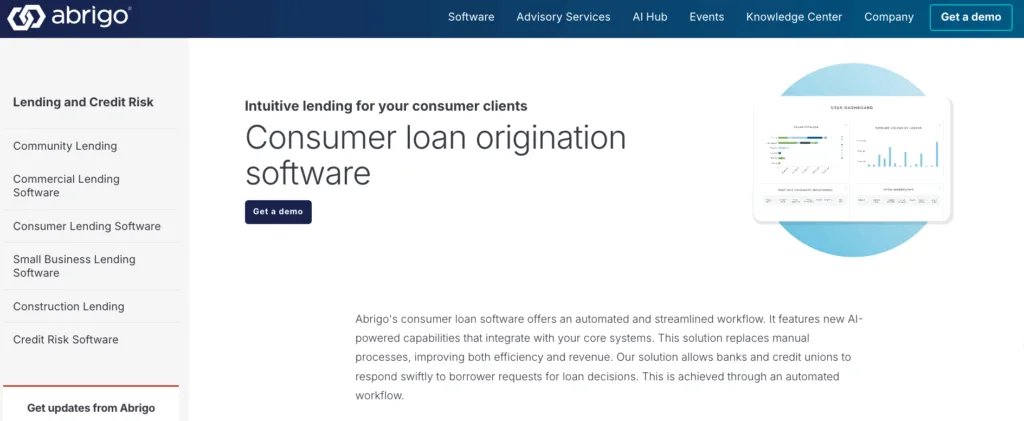
Best for: Banks and credit unions seeking integrated loan origination and servicing with advanced risk management tools.
Abrigo offers an end-to-end lending platform focused on community financial institutions. The system provides automated workflow with AI-driven decisioning capabilities, built-in CRM, and lending process templates. Abrigo’s consumer lending module tracks the full borrower journey from prospect to serviced loan, with integrated portfolio analytics and CECL provisioning.
Ideal For:
- Community banks and credit unions
- Institutions wanting one system for origination and servicing
- Organizations needing built-in CECL and ACL tools
- Banks requiring borrower analytics
- Lenders seeking workflow automation
Core Features:
- Integrated customer record and CRM
- Workflow management with customized loan pipelines
- Automated decision templates based on policy
- Document management portal
- Cross-sell analytics
- Unified data across loans
Key Strengths:
Abrigo combines origination, servicing, and portfolio risk in one suite with strong customer support. The platform won recognition for client service in industry surveys and offers scalable SaaS infrastructure. Users benefit from automated underwriting and comprehensive data integration across lending operations.
Limitations:
Heavy focus on origination workflows with less emphasis on modern servicing features. The system may be complex for very small lenders. Pricing and deployment are tailored to larger institutions. Implementation timelines can be significant.
Pricing:
Customized per deployment. Contact vendor for quote.
3. MeridianLink Consumer
Best for: Banks and credit unions needing modern, highly configurable loan origination and onboarding platforms.
MeridianLink Consumer is a cloud-based loan origination system that centralizes multi-channel applications into one platform. The system excels at creating seamless borrower experiences and enabling digital workflows, with over 1,000 configuration points and dozens of fintech integrations. The platform includes powerful underwriting, pricing engines, and rules-driven decisioning workflows.
Ideal For:
- Community banks and credit unions
- Midsize lenders seeking fully digital consumer LOS
- Institutions wanting extensive customization without coding
- Organizations focused on digital transformation
- Banks needing cross-sell capabilities
Core Features:
- Advanced automated underwriting and decision engine
- Web-based, cloud-native LOS
- Support for personal loans, auto, credit cards, and other loan types
- Dynamic workflows
- Borrower portals and secure digital documents
- Built-in dashboards and MeridianLink Insight reporting
Key Strengths:
Widely adopted in finance with frequent SaaS updates ensuring compliance. Highly configurable user experience with robust reporting capabilities. The platform enables extensive customization and supports multiple loan types through a modern interface.
Limitations:
Focuses primarily on origination. The servicing module requires integration with other systems. Enterprise-level implementation time required. Licensing geared toward larger financial institutions rather than small lenders.
Pricing:
Enterprise model. Contact the vendor for a quote.
4. LoanPro
Best for: Innovative fintechs and lenders needing flexible, API-driven lending platforms across origination, servicing, and collections.
LoanPro is a composable, API-first loan management platform used by over 600 lenders managing 30M+ accounts. The system covers the full credit lifecycle with extreme configurability through its Modern Lending Engine, real-time ledger, and powerful automation capabilities. Loan events like payments and modifications are handled automatically, reducing manual work significantly.
Ideal For:
- Fintechs and neobanks building custom loan products
- Large lenders managing diverse consumer portfolios
- Teams wanting to innovate without legacy system constraints
- Organizations requiring API-driven flexibility
- Lenders seeking composable architecture
Core Features:
- API-first architecture with REST APIs for every function
- Real-time borrower ledger
- Rule-based payment waterfalls
- Custom fields and logic
- Integrated payments and collections suite
- Automated notifications
- Data-on-Demand reporting
Key Strengths:
Unmatched flexibility allowing new products to launch in weeks. Highly automated servicing engine reduces errors and improves operational efficiency. Strong security and compliance with SOC 2 certification. The platform provides unprecedented control for risk-averse lenders. For platform comparisons, see our Nortridge vs. LoanPro analysis.
Limitations:
Relies on developer resources rather than a drag-and-drop LOS interface. Enterprise pricing structure. Complexity may be excessive for very small lenders without technical teams.
Pricing:
Subscription based on usage or revenue. Contact the vendor for a quote.
5. TurnKey Lender
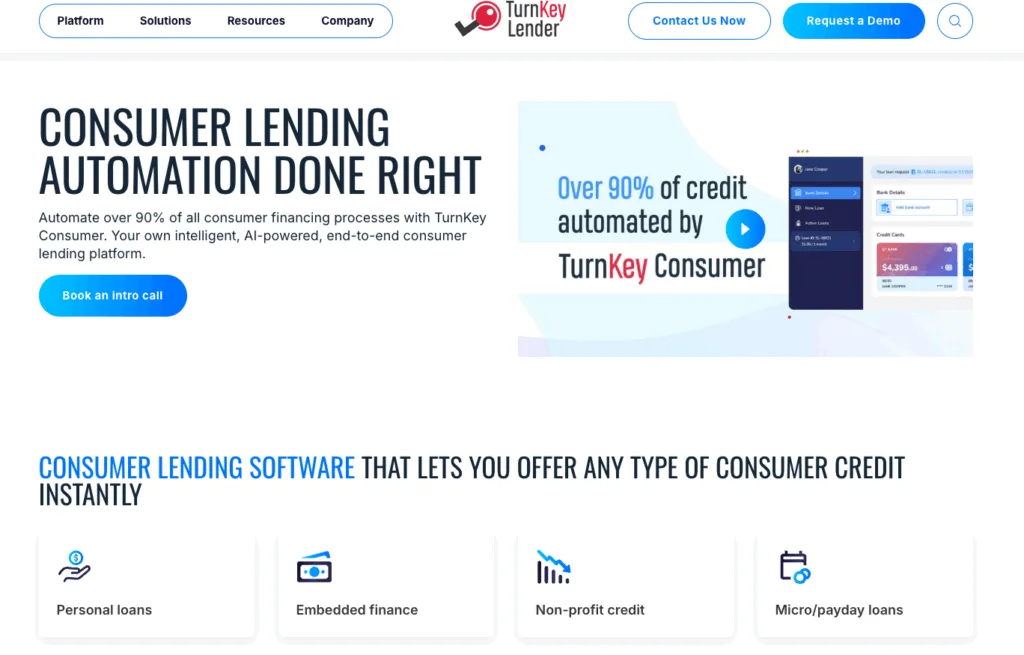
Best for: Lenders seeking AI-powered automation across diverse consumer finance products, including installment loans, BNPL, and auto financing.
TurnKey Lender is a cloud lending platform that emphasizes AI-driven decisioning and fully automated loan processes. The system claims to automate over 90% of consumer financing processes with its intelligent workflow engine, supporting virtually any consumer credit product with pre-configured credit policies and scoring models for each vertical.
Ideal For:
- Non-bank lenders and specialty finance firms
- Banks launching new loan or credit products
- Lenders in underserved segments like BNPL and payday
- Organizations seeking high automation levels
- Finance companies managing multiple product lines
Core Features:
- AI-powered underwriting and credit scoring
- Flexible loan structures, including fixed, revolving, and amortizing
- End-to-end workflow from origination to payoff
- Analytics and automated reporting for each product line
- Built-in fraud checks and ML-driven risk scoring
- Ready-made vertical solutions for multiple industries
Key Strengths:
Ready-made vertical solutions for medical, leasing, BNPL, and other specialized lending. High degree of automation reduces operational costs significantly. Built-in fraud detection and machine learning-driven risk scoring enhance decision quality.
Limitations:
Can be complex to configure across multiple product types. Best suited for mid-to-large lenders with technical resources. Relatively new entrant requiring verification of maturity in specific markets.
Pricing:
SaaS-based, likely volume or module-based. Contact the vendor for a quote.
6. HES LoanBox
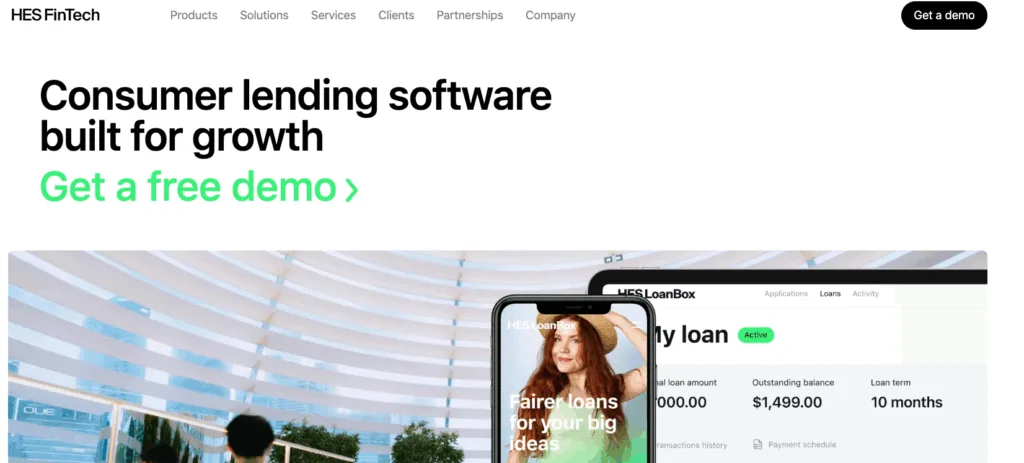
Best for: Banks and alternative lenders needing quick, cloud-based personal loan origination and servicing solutions.
HES FinTech’s LoanBox is a modern cloud-first loan platform covering personal loans end-to-end. The system emphasizes rapid deployment with 90% of clients launching in approximately 3 months, offering configurable workflows that automate the entire lending process from application through servicing.
Ideal For:
- Retail banks and credit unions
- Fintechs launching personal loan programs quickly
- Lenders seeking a fully digital front and back-end
- Organizations needing fast implementation
- Banks requiring standard consumer loan support
Core Features:
- Digital customer onboarding with credit bureau integration
- Automated underwriting workflows
- Secure loan servicing for payments and collections
- Built-in compliance checks and customizable contract templates
- API integrations with payment gateways and account systems
- Portfolio dashboards with real-time insights
Key Strengths:
Fast implementation with out-of-the-box workflows and flexible rule engine. Strong support with a 24/7 service desk. Proven in 32 countries, serving microfinance to consumer banks. Form designer enables customization without extensive coding.
Limitations:
Focus on standard consumer loans with less emphasis on commercial or specialized products. Smaller vendor profile in some markets compared to larger platforms.
Pricing:
Subscription fee based on loan volume or active accounts. Contact the vendor for a quote.
7. Blend (Consumer Banking Suite)
Best for: Banks and credit unions looking to unify deposit onboarding and consumer loan origination on modern digital platforms.
Blend’s Consumer Banking Suite is a digital point-of-sale for banking that focuses on front-end experience, including account opening and loan applications. With Blend, one application can handle multiple products through a shopping cart approach, offering smooth, mobile-friendly UI with autofill features to reduce origination costs and boost conversion.
Ideal For:
- Institutions focused on digital transformation and customer experience
- Banks wanting unified front-end for member onboarding and lending
- Organizations seeking to add digital mortgages, auto, or personal loans
- Credit unions modernizing application processes
- Banks prioritizing conversion optimization
Core Features:
- Digital application portals for mobile and web
- Multi-product support, including deposits, loans, and cards in one flow
- Automatic decisioning integration
- Cross-sell shopping cart functionality
- Analytics on funnel conversion
- Reduced manual data entry
Key Strengths:
Top-notch user experience endorsed by customer case studies. Rapid time-to-value for digital lending initiatives. Reduces redundant work for staff while improving application completion rates.
Limitations:
Primarily a front-end origination layer rather than core servicing engine. Requires underlying LOS and servicing systems for fulfillment. Platform costs can be high. Not suitable for organizations needing comprehensive loan management.
Pricing:
Per-seat or per-use enterprise model. Contact the vendor for a quote.
8. ABLE Platform
Best for: Banks and microfinance institutions needing fully configurable, end-to-end retail lending systems.
ABLE Platform is a multi-module lending suite covering origination, scoring, servicing, and collections designed for banks and credit unions. The system automates the entire credit process for any loan type with AI-driven credit scoring and affordability models, flexible customer onboarding, and complete collections modules. Everything is 100% customizable with no coding required.
Ideal For:
- Financial institutions in emerging markets
- Alternative lenders requiring tailor-made loan processes
- Microfinance organizations expanding to digital lending
- Banks needing advanced risk analytics
- Institutions seeking low-code customization
Core Features:
- Full loan lifecycle support
- Customizable underwriting and scoring framework
- Early-warning alerts for credit risk
- Integrated digital documentation and e-signature
- Detailed configurable reporting
- Machine-learning risk models
Key Strengths:
Highly adaptable low-code platform with strong compliance support for global regulatory requirements. Scalable architecture that grows with portfolio size. Fast time-to-market with 2-4 month deployments is typical. Advanced ML-driven risk analytics built in.
Limitations:
Smaller US footprint with best suitability for international or microfinance use cases. May require internal IT engagement for full customization. Less established in traditional U.S. consumer lending markets.
Pricing:
Custom pricing per module. Contact the vendor for a quote.
9. Finastra

Best for: Large banks and credit unions needing broad, enterprise retail lending suites with strong compliance and document automation.
Finastra offers one of the most comprehensive retail lending platforms, combining consumer and commercial loan modules. Its digital origination and loan management tools including LaserPro, DecisionPro, and Originate support the full process from application to closing. The suite is cloud-native and tightly integrated with core banking solutions, used by over 4,200 community banks and credit unions.
Ideal For:
- Large financial institutions wanting single vendor solutions
- Banks needing turnkey, compliance-rich systems at scale
- Institutions requiring automated document generation
- Organizations with significant IT resources
- Banks needing complete loan, deposit, and mortgage coverage
Core Features:
- Digital account opening and loan origination for consumer, auto, personal, and HELOC
- Automated document generation through LaserPro and Conductor
- AML and fraud screening
- Analytics and borrower self-service portals
- Configurable underwriting workflows through DecisionPro
- Built-in regulatory controls with compliance guarantee
Key Strengths:
Proven reliability in large portfolios with extensive legal and compliance support. Strong ecosystem of Finastra products enabling unified operations. Global support resources and $2M compliance guarantee on documents. Comprehensive platform for complex banking needs.
Limitations:
Complex and costly to implement with long deployment timelines. Less flexible than niche platforms. Best suited for institutions with significant IT resources. It may be excessive for smaller lenders.
Pricing:
Enterprise licensing on a case-by-case basis. Contact the vendor for a quote.
For a detailed platform comparison, see our Nortridge vs. Finastra guide.

How to Choose the Right Consumer Lending Software
Not all consumer lending software covers the full loan lifecycle. Many platforms specialize in loan servicing, portfolio management, and post-origination operations, which is where complexity and risk increase as loan volume grows.
When evaluating consumer lending software, lenders should focus on how well a platform supports ongoing loan management, compliance, and scalability rather than just origination features. For comprehensive guidance, see our article on how to select loan management software.
1. Loan Servicing and Portfolio Management Depth
Once a loan is originated, servicing becomes the long-term operational burden. The right platform should support ongoing payment processing, interest accruals and fee management, delinquencies and modifications, and accurate balances across thousands of active loans.
Platforms built primarily for origination often lack the servicing depth needed for large consumer portfolios. Look for systems that excel at managing loans after funding rather than stopping at the approval stage.
2. Support for Complex Consumer Loan Structures
Many consumer lenders manage more than simple, fixed-term installment loans. Evaluate whether the software supports variable payment schedules, adjustable rates, custom fees and add-ons, and mid-loan changes without manual workarounds.
Servicing flexibility becomes critical as portfolios diversify. The platform should handle payment structure variations natively rather than requiring constant workarounds or custom development.
3. Compliance, Auditability, and Regulatory Controls
Consumer lending software should help reduce operational risk by providing built-in compliance safeguards, clear audit trails for every loan event, and accurate interest and fee calculations.
Strong auditability is especially important for lenders operating at scale or under increased regulatory scrutiny. The system should maintain detailed logs and support regulatory reporting requirements without manual intervention.
4. Reporting and Portfolio Visibility
Managing consumer loans at scale requires real-time insight. Look for portfolio-level dashboards, delinquency and performance tracking, and custom reporting for internal teams and regulators.
Manual reporting increases risk and slows decision-making as portfolios grow. Automated reporting capabilities, including delinquency aging and provisioning reports, speed operational response and improve accuracy.
5. Scalability and System Reliability
Consumer loan servicing systems must perform consistently over time. Consider whether the platform can handle high volumes of active accounts, maintain accuracy as portfolios grow, and support future loan products without re-platforming.
Scalability challenges often surface months or years after implementation. Choose platforms proven at your target portfolio size, not just your current volume.
6. Integration With Upstream Systems
Even without native origination, consumer lending platforms should fit into a broader lending ecosystem. Evaluate how the software connects with existing loan origination systems, payment processors, accounting and reporting tools, and CRM systems.
Flexible integrations help lenders avoid operational silos and reduce duplicate entry. API capabilities and pre-built connectors determine how easily the platform fits your existing infrastructure.
7. Implementation, Support, and Long-Term Partnership
Consider what ongoing ownership looks like, including implementation complexity and timelines, training and onboarding support, responsiveness of customer support, and product roadmap and long-term viability.
Consumer lending software is not a short-term decision. Vendors should act as long-term partners, providing ongoing guidance, product updates, and responsive support as your needs evolve.

Frequently Asked Questions
What is a consumer lending platform?
Consumer lending software manages and services consumer loan portfolios after origination. It tracks balances, payments, interest, fees, delinquencies, and account changes across large loan volumes while supporting compliance and reporting.
What features should consumer lending software include?
Consumer lending software should include robust loan servicing, flexible payment management, compliance controls, detailed reporting, and scalable delinquency management. High-volume platforms require automation to reduce manual tasks and errors.
Is consumer lending software the same as loan origination software?
No. Consumer lending software focuses on loan servicing and portfolio management after origination, while loan origination software handles application intake and underwriting. Many lenders use separate systems for each function.
Who uses consumer lending software?
Banks, credit unions, fintech lenders, and specialty finance companies managing personal loans, installment loans, and lines of credit use consumer lending software. It supports large or complex loan portfolios effectively.
How much does consumer lending software cost?
Consumer lending software costs vary based on portfolio size, loan complexity, deployment model, and support needs. Pricing typically reflects active accounts, transaction volume, or licensing structure rather than flat fees.
Find a Consumer Lending Platform That Scales With Your Portfolio
The right consumer lending software supports your portfolio, streamlines operations, and grows with your business. Nortridge Loan System is built for loan servicers and lenders who need flexibility, control, and powerful tools across the entire consumer loan lifecycle.
Here’s what makes Nortridge the configurable solution for complex consumer portfolios:
- Configurable workflows that mirror your internal procedures
- 150+ standard reports with endless reporting possibilities
- Multi-channel payment processing with waterfall distribution
- U.S.-based support and consulting services
- 40+ years of experience managing $750B+ in active loans
- Flexible integration framework with extensive APIs
- Scalable architecture that grows with your portfolio
Nortridge supports any consumer loan type and scales with your business. Schedule a demo today to see how Nortridge fits your consumer installment loan software operations.