
10 Best Auto Finance Software Evaluated (2026)

The auto finance software market in 2026 offers specialized platforms built specifically for vehicle lending operations. The right system handles everything from dealer integrations and collateral tracking to payment processing and collections, giving lenders the tools needed to manage high-volume auto loan portfolios efficiently. This guide compares the top 10 auto finance software platforms for 2026, breaking down features, pricing, strengths, and limitations so you can find the platform that fits your lending operations.
Note: Some platforms on this list specialize in specific parts of the lending lifecycle, such as origination or decisioning, rather than providing full end-to-end loan management. We’ve clearly identified which systems require additional tools for complete auto loan operations.
Key Takeaways:
- Configuration flexibility separates top platforms – the best auto finance software adapts to your business rules rather than forcing you into rigid workflows, supporting diverse payment structures and loan terms.
- Vehicle-specific features matter for efficiency – collateral tracking, VIN-level data, dealer workflows, and repossession management tools designed specifically for auto lending reduce manual work and improve accuracy.
- Integration capabilities determine long-term success – seamless connections to credit bureaus, payment processors, dealer management systems, and accounting platforms prevent data silos and enable portfolio growth.
- Pricing models vary significantly – understanding whether a platform charges per loan, per user, or through subscription fees helps you calculate true costs as your portfolio scales.
Table of Contents
- Quick Comparison: Top Auto Finance Software
- How We Evaluated These Auto Finance Platforms
- 10 Best Auto Finance Software Platforms in 2026
- How to Choose the Right Auto Finance Software
- Frequently Asked Questions
- Compare Auto Finance Platforms With Confidence
Quick Comparison: Top Auto Finance Software
Here’s a quick overview of the best auto finance software platforms for 2026 and what makes each one stand out.
| Platform | Best For | Includes Servicing? |
| Nortridge Loan System | Loan servicers managing complex auto portfolios with diverse loan structures | Yes |
| LoanPro | Tech-forward lenders needing modern, API-first auto loan infrastructure | Yes |
| defi SOLUTIONS | High-volume lenders needing a full auto finance lifecycle solution with configurable automation | Yes |
| Shaw Systems | Established auto lenders needing robust dealer and lease financing features | Yes |
| ABLE Platform | Auto dealers seeking branded in-house financing programs | Origination only |
| Solifi | Large-scale auto captives needing robust SaaS platform with fast automated origination | Yes |
| Bryt Software | Smaller lenders seeking affordable, quick-start auto lending software | Yes |
| TIMVERO | Large institutions requiring full control and compliance at the code level | Yes |
| Provenir | Auto finance companies optimizing underwriting and risk scoring with AI-powered decisioning | Decisioning only |
| Fuse Finance | Lenders seeking a modern, configurable origination engine with built-in decisioning | Origination only |
How We Evaluated These Auto Finance Platforms
Choosing auto finance software for your lending tech stack depends on how well it supports vehicle-backed lending, scales with your portfolio, and reduces manual work across origination, servicing, and collections. To rank the top systems for 2026, we used a clear set of criteria that auto lenders rely on when comparing platforms.
Here is what we looked at:
- Auto loan lifecycle support from origination through servicing
- Vehicle-specific features, including collateral tracking and VIN management
- Payment processing capabilities and waterfall distribution
- Collections and repossession workflows
- Dealer integration capabilities for indirect lending
- Integration with credit bureaus and payment processors
- Reporting and portfolio analytics tools
- Deployment flexibility with cloud, on-premise, or hybrid options
- Transparent pricing for auto finance features
This framework lets you compare the top auto finance software systems in 2026 and see how each platform aligns with your vehicle lending needs.
10 Best Auto Finance Software Platforms in 2026
The auto finance software landscape in 2026 offers more specialized choices than ever. The best platform depends on your lending model, loan volume, and whether you need dealer integration or direct-to-consumer capabilities. This guide compares 10 leading systems across features, pricing, strengths, and limitations to help you find the right fit.
1. Nortridge Loan System

Best for: Loan servicers and lenders managing complex auto portfolios with diverse loan structures and high customization needs.
Nortridge Loan System is a configurable lending and loan servicing platform built for loan servicers and lenders who need powerful loan processing workflows, end-to-end lifecycle control, and the flexibility to support any auto loan type. With 40+ years in business and trusted by loan servicers managing over $750B in active loans, Nortridge serves operations teams, compliance managers, and IT professionals across the auto finance industry.
Ideal For:
- Auto lenders managing diverse vehicle portfolios
- Buy-here-pay-here operations needing flexible servicing
- Loan servicers requiring end-to-end lifecycle control
- Captive finance companies handling dealer programs
- Operations teams needing detailed audit trails
- IT teams wanting robust APIs and database access
Core Features:
- Configurable workflows for auto loan servicing
- Multi-channel payment processing with waterfall distribution
- VIN-level collateral tracking with unlimited collateral support
- Extensive reporting with 150+ standard reports
- Built-in collections module with automated workflows
- API framework for dealer management system integrations
- Support for direct and indirect auto lending models
Key Strengths:
Nortridge supports virtually all auto loan types with highly configurable workflows, deep reporting capabilities, and robust payment processing. With U.S.-based support and 40+ years of experience, the platform handles complex structures with flexible collateral management and open database access. The system adapts to your business rules rather than forcing you into rigid processes.
Limitations:
Configuration complexity requires skilled users. The UI is less modern than newer platforms. Nortridge does not offer built-in credit decisioning tools but integrates with third-party systems for underwriting. Steeper learning curve for full utilization.
Pricing:
Nortridge SaaS pricing starts at $1,140/month for up to 3 users. Pricing scales with usage and modules rather than per-loan fees.
Ideal For Car Lenders Who Want:
- Full control over auto loan servicing policies
- Configurable workflows for diverse vehicle loan structures
- Powerful payment processing with flexible distribution rules
- Scalable architecture supporting portfolio growth
- Flexible integration with existing dealer and payment systems
2. LoanPro
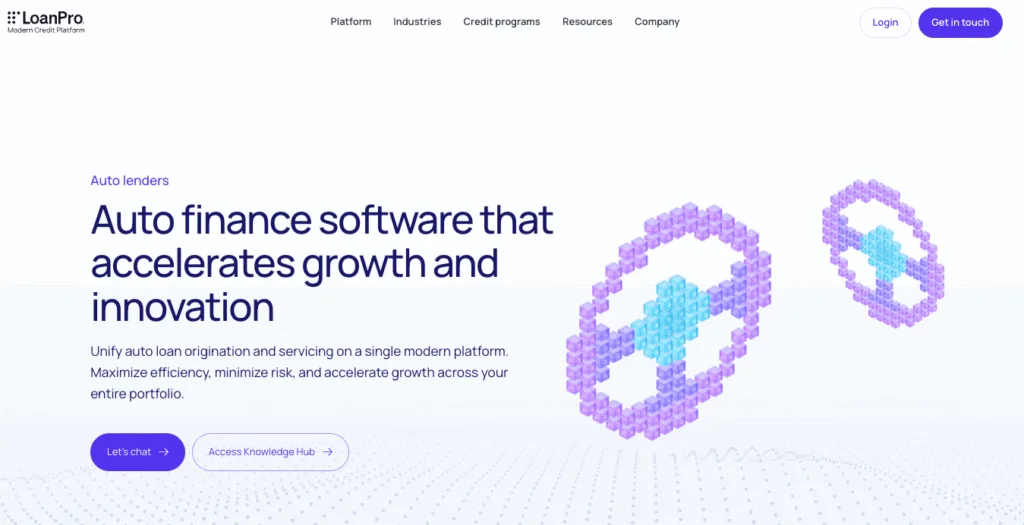
Best for: Tech-savvy lenders needing a modern, API-driven loan platform for auto finance operations.
LoanPro is a cloud-native, API-first lending platform serving over 600 lenders with 30M+ loans. The system provides end-to-end loan lifecycle support including origination, servicing, and collections in a composable architecture. Lenders use LoanPro for auto loans as well as consumer and business lending, with its low-code rules engine enabling rapid automation of servicing tasks.
Ideal For:
- Banks and credit unions modernizing auto loan systems
- Finance companies scaling auto loan programs
- Fintechs launching innovative vehicle financing products
- Growing lenders requiring robust automation
- Tech-forward operations teams wanting API flexibility
Core Features:
- API-first architecture with 600+ endpoints
- Full loan lifecycle modules for origination and servicing
- Automation engine for rule-based workflows
- Multi-channel payment processing with ACH and card support
- Real-time transaction history and reporting
- Borrower self-service portals
- Integration with 100+ data providers
Key Strengths:
LoanPro’s flexible, configurable engine empowers lenders to innovate without rigid workflows. Users praise its robust API and automation capabilities. The platform is highly scalable and cloud-based, with 24/7 support available. Many lenders see improved efficiency and risk management after switching to LoanPro. For more details on how LoanPro compares, see our Nortridge vs. LoanPro comparison.
Limitations:
Some users report a steep learning curve. LoanPro requires technical expertise to implement its APIs and configure advanced automation. Smaller lenders should be prepared for initial setup complexity.
Pricing:
Not publicly disclosed. Pricing is customized based on loan volume and required features.
3. defi SOLUTIONS
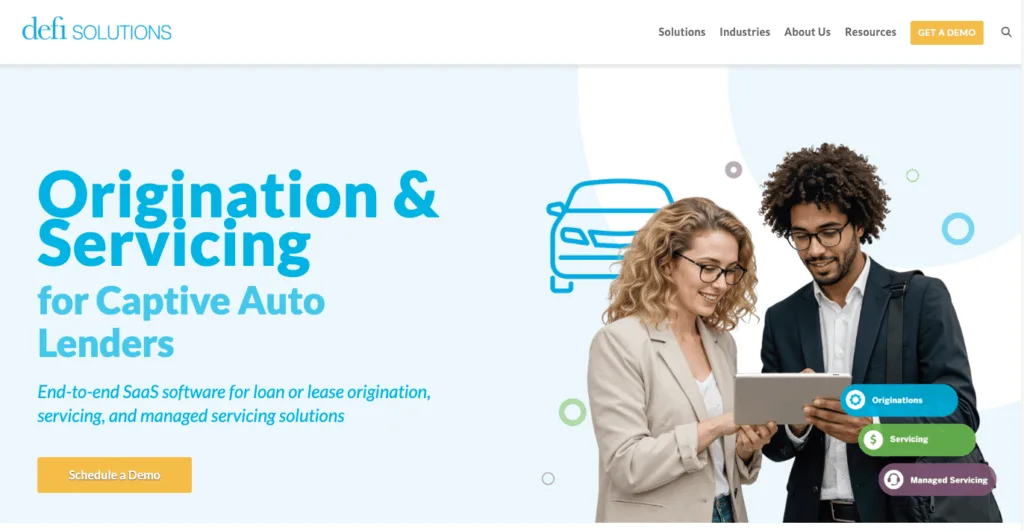
Best for: High-volume lenders needing a full auto finance lifecycle solution with configurable automation.
defi SOLUTIONS provides a comprehensive auto and consumer lending suite called defiOS. It is an end-to-end platform covering loan and lease origination, servicing, and outsourced servicing for auto financiers. The platform includes a modern origination engine and feature-rich servicing system, with tools supporting collections, repossession, and remarketing under one roof.
Ideal For:
- Captive auto finance companies
- Independent finance companies
- Community and regional banks with auto loan programs
- Credit unions offering auto loans
- High-volume operations requiring scalability
Core Features:
- Digital origination with an online borrower portal
- Configurable underwriting with a rules-driven engine
- High-availability account management platform
- Collections and recovery with repossession tracking
- Integration ecosystem with 100+ third-party partnerships
- Flexible deployment with cloud-native architecture
Key Strengths:
Defi is backed by over 30 years’ experience serving large auto lenders, with more than $1 trillion in originations to date. Its all-in-one suite reduces the need for multiple vendors. The platform is highly configurable and continuously developed, ensuring lenders can tailor the system to changing business rules and scale efficiently. Defi boasts strong customer support and a 98% client retention rate.
Limitations:
As an enterprise-grade suite, defiOS may be too complex for very small lenders or single-dealer operations. Implementation typically requires coordination. Pricing and ROI may be higher compared to simpler solutions, with details not disclosed. Some users may find the system’s flexibility requires thorough training.
Pricing:
Not publicly listed. Custom quotes based on modules and services.
4. Shaw Systems (Spectrum)
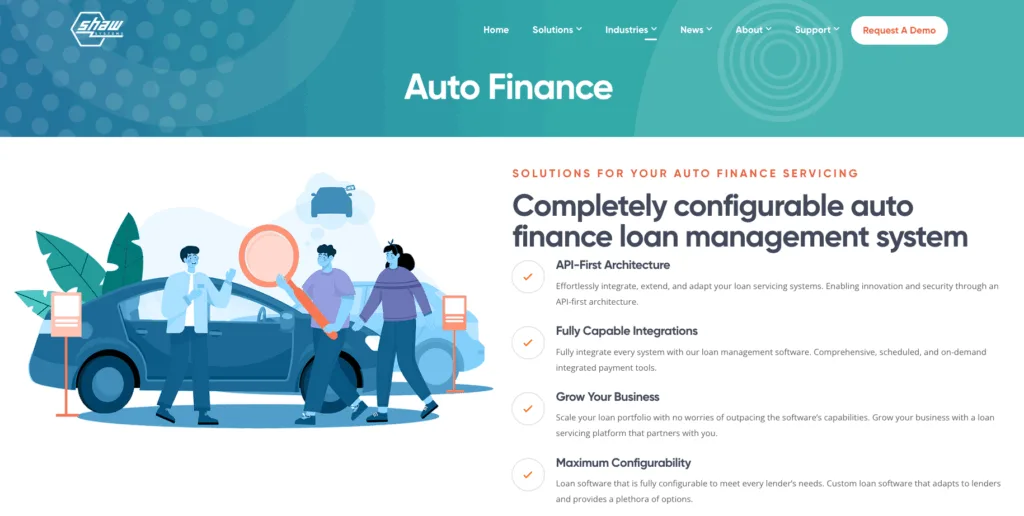
Best for: Established auto lenders needing robust dealer and lease financing features.
Shaw Systems’ Spectrum platform is a veteran loan and lease servicing solution founded in 1967, focused on automotive and lease finance. It offers specialized modules for auto financing, dealer floor-plan lending, and managed leases. The system handles the full servicing cycle, including dealer portal functions and lease accounting with integrated insurance and fee processing.
Ideal For:
- Banks and credit unions with auto loan and lease portfolios
- OEM captive finance subsidiaries
- Independent auto finance companies
- Large franchise dealer groups offering floor-plan financing
- Specialty lenders focusing on leasing
Core Features:
- Auto and lease servicing supporting simple-interest and add-on loans
- Dealer and floor-plan module with self-service portal
- Tax and insurance processing for leases
- Fee and escrow management
- Collections and recovery workflows
- Reporting and compliance with general ledger integration
Key Strengths:
Shaw’s decades of industry focus deliver battle-tested auto financing tools. The platform includes ready-to-deploy auto-specific configurations, so lenders can implement quickly with pre-built business rules. Its longevity has produced a stable, comprehensive product. Many lenders appreciate the depth of its dealer and lease features. On-premise or hosted deployment is available.
Limitations:
Shaw Spectrum is largely an on-premises solution with significant up-front license fees. The complexity of its many options can be overkill for smaller lenders. Its user interface and customization flexibility are generally considered more dated than newer SaaS platforms. Implementation can be time-consuming. For a detailed comparison with other platforms, see our Nortridge vs. Shaw Systems guide.
Pricing:
Typically starts at around $50,000 for an on-premise license. Cloud-hosted Spectrum is available with quote-based pricing.
5. ABLE Platform
Best for: Auto dealers or equipment retailers seeking to offer on-the-spot, owner-managed financing.
ABLE Platform is an in-house financing solution for merchants. It lets dealers and contractors launch white-label loan programs so customers can finance large purchases directly from the seller. For auto dealers specifically, ABLE provides an approval workflow, branded loan offers, and automated decisioning, allowing dealers to retain 100% of the interest income.
Important Note: ABLE is an origination-focused platform designed for point-of-sale financing. It does not provide full loan servicing capabilities, collections management, or compliance features found in comprehensive loan management systems.
Ideal For:
- Car dealerships wanting branded in-house financing
- Equipment and specialty retailers needing point-of-sale loans
- HVAC and electrical contractors offering payment plans
- Sellers of medical or fitness services requiring financing
Core Features:
- Branded loan origination with dealer-branded application forms
- Automated underwriting with customizable credit decisioning rules
- Customizable terms with full control over pricing and approval criteria
- Customer self-service portal for applications and payments
- Payment and accounting with integrated processing
- Automated notifications via SMS and email
Key Strengths:
ABLE lets dealers keep 100% of the loan margin with no middleman fees or commissions. This drives higher sales conversions as customers get financing instantly on the dealer’s terms. The platform’s quick setup and white-label flexibility mean dealers control branding and customer experience. Many merchants find its vendor-neutral model and U.S.-based support advantageous over bank-driven alternatives.
Limitations:
ABLE is focused on point-of-sale financing and is not a full loan management system. It does not include comprehensive back-office servicing, collections management, compliance features, or securitization capabilities. Lenders must still handle outside funding, ongoing loan servicing, and compliance requirements separately. Best suited to dealers who regularly originate consumer loans themselves and have separate systems for post-origination management.
Pricing:
Pricing and contract terms are customized and not publicly listed. Contact ABLE for pricing.
6. Solifi (Leasepath)
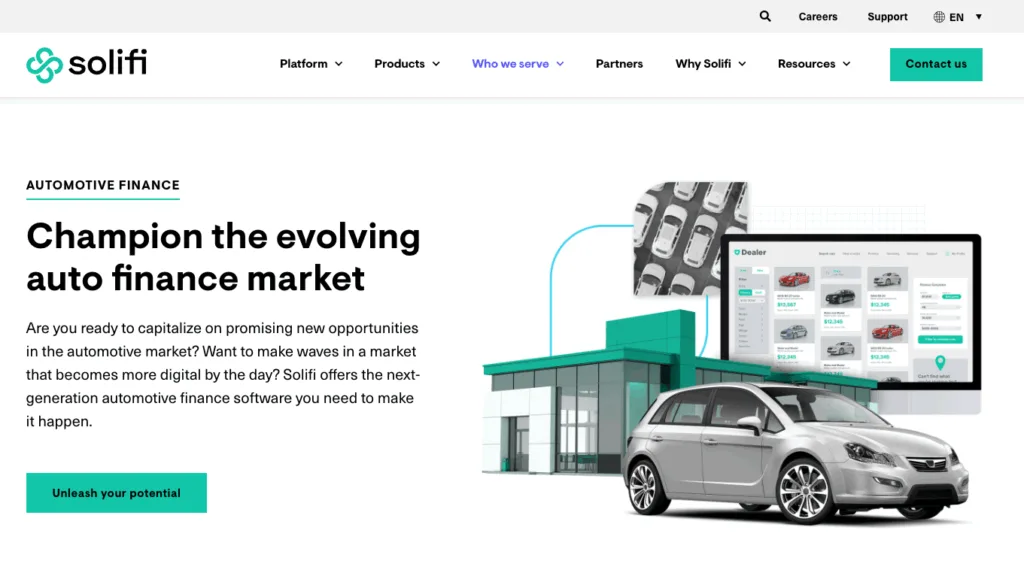
Best for: Large-scale auto captives and finance companies needing a robust SaaS platform with fast, automated origination.
Solifi offers cloud-based lending software for automotive finance. Its Solifi Open Finance Platform provides end-to-end origination and portfolio management tools, originally built for leasing programs but now supporting loan products as well. Key components include an application portal, credit decision engine, payment automation, and accounting-ledger integration. Solifi is used by large captives and banks to digitize and scale auto lending.
Ideal For:
- OEM captive finance arms and large banks
- Fleet and commercial vehicle finance providers
- Credit unions and regional banks upgrading legacy systems
- Finance companies seeking modern origination capabilities
Core Features:
- Accelerated origination with instant underwriting
- Configurable credit rules with a flexible rule engine
- Portfolio management with automated billing and payments
- Lease support with integrated accounting through the Leasepath module
- Data and integrations with vehicle data feeds and credit bureaus
- Cloud-native scaling with secure deployment options
Key Strengths:
Solifi is known for its configurability and client successes. Customers praise its ability to fully automate underwriting and decisioning with sub-5-minute approvals. It is highly adaptable, allowing new loan products and strategic partnerships to be implemented without coding. The vendor invests heavily in development, so the platform stays up-to-date with industry trends. Large institutions benefit from proven scalability and advanced analytics.
Limitations:
Solifi is designed for medium and large lenders. Its breadth and enterprise-grade features may be more than needed for very small firms. The solution is relatively young in the U.S. market, and pricing is typically custom. Lenders switching from legacy systems should plan for a significant configuration and integration effort.
Pricing:
Not publicly disclosed. Enterprise pricing based on scale and modules.
7. Bryt Software
Best for: Smaller banks, credit unions, or finance companies seeking affordable, quick-start auto lending software.
Bryt Software is a cloud-native loan management system aimed at small to mid-sized lenders. It supports origination and servicing of auto loans through an easy-to-use, web-based interface. Bryt emphasizes rapid implementation and flexible loan setup, advertising a significant reduction in disbursement time via streamlined onboarding. The platform includes built-in reports, configurable payment schedules, and a master accounting ledger.
Ideal For:
- Community banks and credit unions offering auto loans
- Private financing companies with limited IT resources
- Fintech startups needing fast deployment
- Organizations requiring easy maintenance
Core Features:
- Quick onboarding with streamlined applicant processing
- Loan administration with payment waterfall engine
- Tax and regulatory reports including IRS Form 1098
- Analytics dashboard with real-time widgets
- Cloud hosting with 100% uptime SLA on Microsoft Azure
- REST API for borrower management and payment posting
Key Strengths:
Bryt is praised for its ease of use and customer service. Lenders note that implementation is fast and the vendor is responsive to custom needs. Its seat-based pricing and included support make it cost-effective for smaller portfolios. The system’s flexibility in terms of loan structures and schedules lets lenders tailor products to customers easily. Being fully cloud-hosted means lenders avoid IT overhead.
Limitations:
Bryt is not as feature-rich as enterprise systems. It lacks native capabilities for complex leasing or large commercial lending. The platform is oriented to straightforward consumer and auto loans. Very high volume lenders may outgrow it. Its reporting and UI are basic compared to larger platforms.
Pricing:
Pricing is modular and transparent. Contact vendor for details. A free trial is available, and a free-tier starter plan covers basic loan servicing.
8. TIMVERO
Best for: Large financial institutions requiring full control and compliance at the code level.
TIMVERO’s timveroOS is a next-generation loan management framework built on a policy-as-code philosophy. It brings all loan processes into a single governed system where every rule is defined, versioned, and traceable as code. The platform automates end-to-end servicing with real-time reconciliation and audit logging. timveroOS also includes AI-driven collections to prioritize delinquencies and automate hardship programs.
Important Note: TIMVERO is best suited for institutions with in-house engineering or business systems teams capable of managing policy-as-code implementations.
Ideal For:
- Regional and national banks managing auto loan portfolios
- Fintech lenders who want to iterate rapidly
- Credit unions wanting self-hosted control
- Lenders focused on regulatory compliance and auditability
- Organizations with dedicated IT and business analysis teams
Core Features:
- Policy-as-Code engine with all calculation rules defined as code
- Unified servicing and accounting with automated billing
- AI and ML extensions for collections and event-driven recalculations
- Modularity and APIs with SDKs for extensions
- Flexible deployment in any cloud or on-premises
Key Strengths:
timveroOS offers unprecedented control for risk-averse lenders. By turning every rule into code, it ensures consistency and audit-readiness across all portfolios. Users maintain complete ownership of their system and data with no black-box vendor. The platform is highly scalable, with automated posting and reconciliation greatly reducing operational overhead. Early adopters report dramatically faster month-end closes and stricter compliance.
Limitations:
TIMVERO is complex by design. Smaller lenders or those without strong IT and business analysis teams may find its policy-as-code approach difficult to adopt quickly. The focus is on customization and governance rather than out-of-the-box simplicity, so implementation can be lengthy. It does not provide customer-facing origination or CRM modules. Pricing is custom and generally higher-end. This platform requires significant technical resources to implement and maintain effectively.
Pricing:
Not publicly disclosed. Enterprise pricing based on scale and features.
9. Provenir
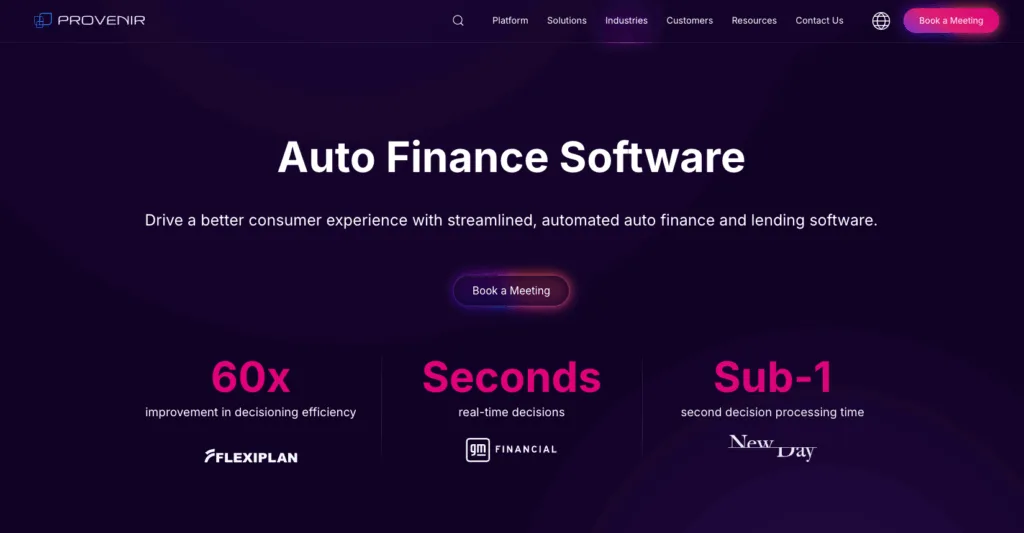
Best for: Auto finance companies looking to optimize underwriting, risk scoring, and fraud checks with AI-powered decisioning.
Provenir is a decisioning and risk-management platform used by auto lenders, not a loan servicing system. It specializes in credit and fraud decisioning across the lending lifecycle, leveraging AI and a data marketplace to streamline underwriting. For auto finance, Provenir enables real-time credit decisions and automated pricing at origination, helping lenders approve more loans faster while managing risk.
Important Note: Unlike other platforms on this list, Provenir is a decisioning engine designed to integrate with, but not replace, your loan servicing system. Lenders need a separate loan management platform to handle funded loans.
Ideal For:
- Large banks and captives needing advanced credit engines
- Fintech auto lenders seeking rapid product iterations
- Credit unions upgrading from manual underwriting
- Any lender requiring real-time credit approvals and dynamic pricing
Core Features:
- AI-driven decisioning with machine-learning models
- Data Marketplace with on-demand integration of global data sources
- Low-code workflow engine for building underwriting processes
- Real-time scoring and pricing during origination
- Cloud-native microservices architecture for scaling
Key Strengths:
Provenir empowers lenders to approve more loans by automating manual credit checks and ensuring decisions are made instantly. Its platform is used by major auto finance firms to improve approval rates and speed. The system’s flexibility and data connectivity let lenders quickly test new loan products and pricing strategies without rewriting code.
Limitations:
Provenir is focused exclusively on front-end decisioning, not loan servicing, accounting, or collections. Lenders still need a separate loan management software to service loans after origination. It requires a significant data strategy and some technical expertise to configure models. Pricing tends to be enterprise-level and is typically licensed per decision or user.
Pricing:
Not publicly available. Enterprise licensing.
10. Fuse Finance (Fuse)
Best for: Lenders seeking a modern, configurable origination engine with built-in decisioning and integration.
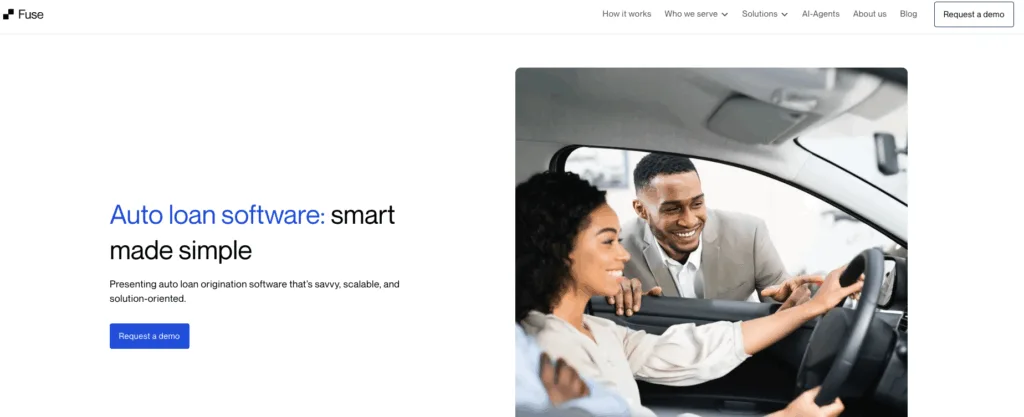
Fuse provides cloud-based origination software for auto lenders. Its AI-enhanced platform automates the front-end loan process. Fuse offers an open API ecosystem integrating 100+ data and tech partners, plus a built-in decision engine that can simultaneously evaluate customers against multiple loan programs and rates. Designed for banks, credit unions, and finance companies, Fuse aims to accelerate loan approvals and improve capture rates.
Important Note: Fuse is an origination-focused platform and does not provide loan servicing capabilities. Lenders need separate systems for post-origination loan management, compliance tracking, and collections.
Ideal For:
- Banks and credit unions wanting to modernize auto loan origination
- Captive finance companies focusing on indirect lending
- Fintechs launching auto loan products via dealer networks
- Any lender needing multi-program decisioning to improve approvals
Core Features:
- Multi-offer decisioning evaluating applicants across all programs
- Custom business rules with a no-code rules builder
- Data integrations with pre-built connections to credit bureaus
- Customer interface with the dealer or borrower portal
- Analytics with pipeline reporting and dashboards
Key Strengths:
Fuse’s origination engine is highly flexible, letting lenders implement even complex indirect lending rules without writing code. Its multi-offer capability helps ensure each applicant sees the best available program. The extensive integration library means lenders can quickly plug in needed services. Because it is cloud-based and AI-aware, Fuse customers often achieve faster turn-times on approvals.
Limitations:
Fuse focuses exclusively on origination and underwriting. It does not include loan servicing, compliance tracking, or collections capabilities. Lenders will need a separate back-end system to handle funded loans, ongoing account management, and regulatory requirements. As a relatively newer platform, it may have fewer large reference customers compared to established incumbents. Like other modern platforms, it requires internal expertise to configure and maintain the rules engine.
Pricing:
Not publicly disclosed. Custom subscription pricing.

How to Choose the Right Auto Finance Software
Selecting the right loan management software depends on your auto-lending model, loan volume, compliance requirements, and how much flexibility you need across origination, servicing, and collections. Before committing to a platform, evaluate both your current needs and how your auto loan portfolio may evolve over time.
1. Define Your Auto Lending Model
Your lending model determines which platform features matter most. Different models have different requirements.
Cover:
- Indirect auto lending with dealer-driven origination
- Direct-to-consumer auto loans
- Buy-here-pay-here operations
- Captive finance or specialty auto lenders
- Subprime versus prime portfolios
Why it matters: Not all platforms handle dealer workflows, loan-to-value logic, or collateralized assets equally. For example, indirect lending requires dealer integrations and holdback calculations, while BHPH operations need flexible payment schedules and in-house collections capabilities.
2. Decide What Parts of the Loan Lifecycle You Need
Break this into clear components:
- Loan origination and decisioning
- Loan servicing and account management
- Payment processing and posting
- Collections and compliance workflows
- Reporting, accounting, and portfolio analytics
Some auto finance platforms specialize in origination or underwriting, while others focus on long-term loan servicing. Many lenders use multiple systems, but others prefer a single, configurable platform that handles the entire lifecycle.
3. Look for Auto-Specific Flexibility
This is a major differentiator in auto finance software.
Key features include:
- Variable interest rates and term lengths
- Balloon payments and deferred payment options
- Dealer fees and add-ons
- Collateral tracking with VIN-level data
- Multiple payment schedules, including weekly and bi-weekly options
- Support for Rule of 78s and simple interest calculations
The best platforms adapt to your business rules rather than forcing you into rigid workflows. If your lending operations require unique payment structures or specialized collateral management, verify the platform supports these capabilities without expensive customization.
4. Evaluate Compliance and Risk Controls
Auto finance software must support compliance requirements specific to vehicle lending.
Important considerations:
- CFPB and state-level compliance tracking
- Regulation Z and Regulation B support
- Audit trails and reporting capabilities
- Rules-based collections workflows
- Charge-off and recovery handling
- Repossession and remarketing workflows
The right platform provides tools to track compliance but does not claim to ensure compliance itself. Look for systems that maintain detailed audit logs, support configurable business rules, and generate compliance reports needed for regulatory oversight.
5. Consider Integration and Data Access
Modern auto finance operations require seamless data flow across multiple systems.
Key integration points:
- API access for custom integrations
- Accounting systems for general ledger integration
- Payment processors for ACH and card transactions
- Credit bureaus for pulling and reporting credit data
- Dealer management systems for indirect lending
- Business intelligence tools for data exports and portfolio analysis
Platforms with robust APIs and direct database access give you more flexibility as your operations grow. If you plan to build custom workflows or connect proprietary systems, verify the platform supports the level of integration you need.
6. Scalability and Long-Term Fit
Consider how the platform will support your growth over time.
Evaluate:
- Can the system support increasing loan volume?
- Does it handle multi-state expansion?
- Can you add new loan products without platform limitations?
- Will it adapt to changing regulatory requirements?
- Does it support internal process automation over time?
The best auto finance software grows with your business. A platform that works for a small portfolio may not scale to handle thousands of loans, multiple states, or complex dealer networks. Choose a system built for the portfolio size you plan to reach, not just where you are today.
7. Understand Pricing and Implementation Realities
Software costs extend beyond the initial license or subscription fee.
Consider:
- License versus usage-based pricing
- Per-loan or per-account fees
- Implementation timelines and costs
- Internal resource requirements for configuration
- Customization costs for specialized workflows
Implementation complexity varies significantly across platforms. Some systems can be deployed in weeks, while others require months of configuration. Factor in the time and expertise needed to get the platform fully operational, and calculate the total cost of ownership over several years rather than focusing only on initial pricing.

Frequently Asked Questions
What is auto finance software?
Auto finance software manages vehicle loans across origination, servicing, payments, and collections. These platforms support vehicle-specific features like collateral tracking, VIN management, dealer workflows, and compliance reporting.
What features should auto finance software include?
Essential features include loan origination tools, payment processing, collections workflows, reporting and analytics, compliance controls, VIN-level collateral tracking, flexible payment schedules, and dealer fee management.
How is auto finance software different from consumer lending software?
Auto finance software is built for asset-backed lending with vehicle collateral management, dealer integrations, loan-to-value logic, repossession workflows, and support for indirect lending models.
How much does auto finance software cost?
Pricing varies based on platform capabilities, loan volume, and deployment model. Most providers use custom pricing influenced by implementation complexity and integrations. Nortridge starts at $1,140/month.
Can auto finance software scale as a lender grows?
Yes. Leading platforms scale with increasing loan volumes and portfolio expansion. They support new products, workflow automation, and regulatory adaptation without platform switching.
Compare Auto Finance Platforms With Confidence
The right auto finance software supports your portfolio, streamlines operations, and grows with your business. Nortridge Loan System is built for loan servicers and lenders who need flexibility, control, and powerful tools across the entire auto loan lifecycle.
Here’s what makes Nortridge the configurable solution for complex auto portfolios:
- Configurable workflows that mirror your internal procedures
- 150+ standard reports with endless reporting possibilities
- VIN-level collateral tracking with unlimited collateral support
- U.S.-based support and consulting services
- 40+ years of experience managing $750B+ in active loans
- Flexible integration framework with extensive APIs
- Scalable architecture that grows with your portfolio
Nortridge supports any auto loan type and scales with your business. Schedule a demo today to see how Nortridge fits your auto financing software operations.