
8 Best Loan Management Softwares for Non-Profit Organizations in 2026

Non-profit lenders and CDFIs manage complex portfolios with limited staff and resources. Tracking multiple funding sources, generating compliance reports, and serving diverse borrower programs creates operational strain. The right CFDI loan management software automates servicing workflows, strengthens reporting capabilities, and scales mission-driven lending without increasing headcount.
Table of Contents
- Quick Summary
- How We Evaluated the Best Loan Management Softwares for Non-Profits
- 8 Best Loan Management Softwares for Non-Profit Organizations in 2026
- Comparison Table
- How to Choose the Right Loan Management Software for a Non-Profit
- Frequently Asked Questions
Quick Summary: Top Loan Management Software for Non-Profits in 2026
Here’s a quick overview of the best loan management software platforms for non-profit organizations in 2026 and what makes each one stand out.
| Platform | Best For |
| Nortridge Loan System | Non-profits and CDFIs needing complete lifecycle management with extensive reporting |
| Fundingo | CDFIs already using Salesforce CRM needing native integration |
| CDFIsolutions | Community lenders prioritizing mission impact measurement |
| LendingFront | Micro and SMB programs wanting fast deployment |
| LoanPro | Non-profits with technical teams needing API-first infrastructure |
| TurnKey Lender | Small to mid-size non-profits wanting AI-driven automation |
| The Mortgage Office | Housing-focused non-profits managing affordable mortgage portfolios |
| Creatio CRM | Non-profits needing combined donor and borrower management |
How We Evaluated the Best Loan Management Softwares for Non-Profits
Choosing the right loan management software depends on how well it supports mission-driven lending processes, scales with portfolio growth, and reduces manual work across diverse loan programs. To rank the top systems for 2026, we used clear criteria that non-profit lenders rely on when comparing platforms.
Here is what we looked at:
- Comprehensive loan tracking for diverse loan programs
- Portfolio management tools for servicing and reporting
- Integration and automation capabilities
- Security and compliance features
- Vendor support and transparent pricing
- Ability to handle multiple funding sources
- Impact tracking and mission measurement tools
- Scalability for portfolio growth
This framework lets you compare the top loan management systems for non-profits in 2026 and see how each platform aligns with your community lending needs.
8 Best Loan Management Software for Non-Profit Organizations in 2026
The non-profit lending software landscape in 2026 offers specialized choices designed for mission-driven organizations. The best platform depends on your portfolio complexity, funding sources, and whether you need integrated impact measurement. This guide compares 8 leading systems across features, pricing, strengths, and limitations to help you find the right fit.
1. Nortridge Loan System
Best for: Non-profit lenders and CDFIs managing complex portfolios with diverse loan structures and extensive reporting requirements.
Nortridge Loan System is a configurable platform built for organizations needing powerful workflows, end-to-end lifecycle control, and flexibility to support any loan type. With 40+ years serving the lending industry and trusted by organizations managing over $750B in active loans, Nortridge serves operations teams, compliance managers, and IT professionals across all lending sectors.
Ideal For:
- Non-profit lenders managing diverse community development portfolios
- CDFIs needing extensive reporting for funders and regulatory agencies
- Organizations handling participations and multi-investor loans
- Operations teams requiring detailed audit trails
- IT teams wanting robust APIs and database access
- Organizations managing microloans, affordable housing, and small business lending
Core Features:
- Configurable workflows for unique non-profit lending programs
- Participation and syndication management for multiple funding sources
- Extensive reporting with 150+ standard reports
- Multi-collateral tracking with detailed records
- Payment processing with configurable waterfall distribution
- API framework for seamless integrations
Key Strengths:
Nortridge supports virtually all loan types with highly configurable workflows and deep reporting capabilities. With U.S.-based support and 40+ years of experience, the platform handles complex structures with flexible collateral management. Open database access enables custom reporting and data warehouse integration for advanced analytics.
Limitations:
Configuration complexity requires skilled users or consulting support during implementation. The interface is functional but less modern than newer cloud-native platforms built in recent years. Nortridge does not offer built-in credit analysis tools but integrates with third-party systems for financial spreading.
Pricing:
Nortridge SaaS pricing starts at $1,140/month for up to 3 users. Pricing scales with usage and modules rather than per-loan fees. Contact Nortridge for customized quotes based on portfolio size and feature requirements.
2. Fundingo
Best for: CDFIs and non-profit lenders already using Salesforce CRM needing end-to-end loan workflows.
Fundingo is a cloud-based platform designed for community lenders requiring tight CRM integration. The system provides loan origination, underwriting, servicing, and analytics in one Salesforce-native environment. Deep integration means organizations using Salesforce get real-time dashboards and customizable workflows without data synchronization issues.
Ideal For:
- Community development credit unions
- Non-profit lenders using Salesforce for fundraising
- Faith-based lenders wanting unified borrower tracking
- Organizations prioritizing CRM-driven workflows
- Small banks needing unified origination and servicing
Core Features:
- Online application portal with configurable intake forms
- Automated underwriting rules and decision logic
- Borrower and investor portals for self-service access
- Integrated CRM via Salesforce for borrower tracking
- Reporting and analytics for portfolio performance and impact
Key Strengths:
CRM integration provides seamless Salesforce coupling for real-time dashboards and unified data. Customization allows flexible loan terms and workflow rules tailored to specialized programs. Automation handles billing, payment processing, and borrower notifications, reducing manual tasks significantly. Organizations already invested in Salesforce maximize existing technology investments.
Limitations:
Salesforce requirement means the best value if organizations already use Salesforce; otherwise integration requires additional setup. Rich features may have learning curves for very small organizations with limited technical resources. Custom pricing requires contacting Fundingo for detailed quotes based on usage and configuration needs.
Pricing:
Pricing varies based on Salesforce environment and user tiers. Contact Fundingo for tailored quotes based on organization size and configuration needs.
3. CDFIsolutions
Best for: Community development lenders prioritizing mission impact measurement and compliance tracking.
CDFIsolutions is a purpose-built platform for CDFI lenders. While the name may sound generic, it refers to dedicated software offering tools for impact tracking and compliance. The platform emphasizes tracking borrower outcomes, measuring economic development results, and satisfying CDFI certification requirements through specialized reporting.
Ideal For:
- Certified CDFIs requiring impact measurement tools
- Non-profit lenders needing CDFI certification documentation
- Organizations managing community development block grants
- Mission-driven lenders prioritizing borrower success metrics
- Community development corporations managing lending alongside projects
Core Features:
- Impact tracking for job creation and business formation
- Compliance reporting for CDFI certification requirements
- Multi-fund accounting for diverse funding sources
- Borrower outcome monitoring for economic development
- Grant management coordinating lending with development grants
Key Strengths:
Purpose-built design specifically serves CDFI missions rather than adapting traditional banking software. Impact measurement tools track community outcomes valued by mission-driven funders and boards. Compliance features satisfy certification requirements without extensive customization or consulting support. Community-focused support team understands CDFI operations intimately.
Limitations:
Specialized focus means less flexibility for organizations with diverse lending products beyond community development. A smaller feature set compared to enterprise platforms may require supplemental tools for complex portfolios. Geographic focus primarily serves the U.S. market with limited international lending support.
Pricing:
Contact CDFIsolutions for custom pricing based on organization size and lending volume.
4. LendingFront
Best for: Micro and SMB programs wanting fast deployment.
LendingFront is a cloud platform focused on borrower experience with online applications and automated underwriting. Machine learning powers credit decisioning, enabling faster approvals for small business and microloan programs. The modern interface appeals to organizations wanting 24/7 borrower access.
Ideal For:
- Non-profit microloan funds
- Credit unions wanting faster approval processes
- Alternative lenders comfortable with fintech solutions
- Organizations prioritizing borrower convenience
- Community lenders seeking operational efficiency
Core Features:
- Online applications with mobile-responsive borrower portals
- Intelligent underwriting using machine learning
- Custom workflows for tailored approval processes
- CRM and communication tools for case management
- Reporting and analytics for portfolio health tracking
Key Strengths:
Improved access enables underserved communities to apply anytime through online portals. Faster funding results from automated underwriting, significantly reducing decision times. Flexibility allows the quick creation of new loan products for small business and consumer lending. Modern interface appeals to both staff and applicants with intuitive navigation.
Limitations:
Not a full banking core, primarily serving as an origination and servicing layer requiring data export for the general ledger. New fintech features may require initial training for teams used to manual workflows. Learning curve exists for organizations accustomed to manual underwriting processes.
Pricing:
Custom pricing available. Contact LendingFront for quotes based on lending volume and features needed.
5. LoanPro

Best for: Tech-forward non-profits with development resources needing API-driven configurability.
LoanPro is a cloud system emphasizing automation and integration through robust APIs. The platform handles origination through servicing with advanced workflow automation and comprehensive reporting. API-first architecture suits organizations with in-house developers or wanting custom integrations with existing financial systems.
Ideal For:
- Credit unions with technical teams
- Digital lenders comfortable with development resources
- Community development organizations with complex workflows
- Organizations handling diverse loan products
- Larger non-profit funds preferring API-driven approaches
Core Features:
- Loan origination from application through funding
- Automated underwriting and boarding processes
- Flexible product templates for diverse loan types
- Automated payment and fee processing
- REST API and webhooks for system integration
- Robust reporting and dashboard capabilities
Key Strengths:
Extensive automation reduces manual tasks across the loan lifecycle significantly. Multi-platform cloud-native design enables access from anywhere with self-service portals. Customization creates nearly any loan scenario through flexible configuration tools. API framework enables organizations to build custom integrations matching specific technology stacks.
Limitations:
Complexity requires technical resources, making it less suitable for small teams without developers. Support likely needs in-house expertise to fully leverage API capabilities. Higher-end pricing typically requires larger budgets than simpler turnkey solutions.
Pricing:
Subscription-based pricing requires contacting LoanPro for custom quotes based on usage and features.
6. TurnKey Lender
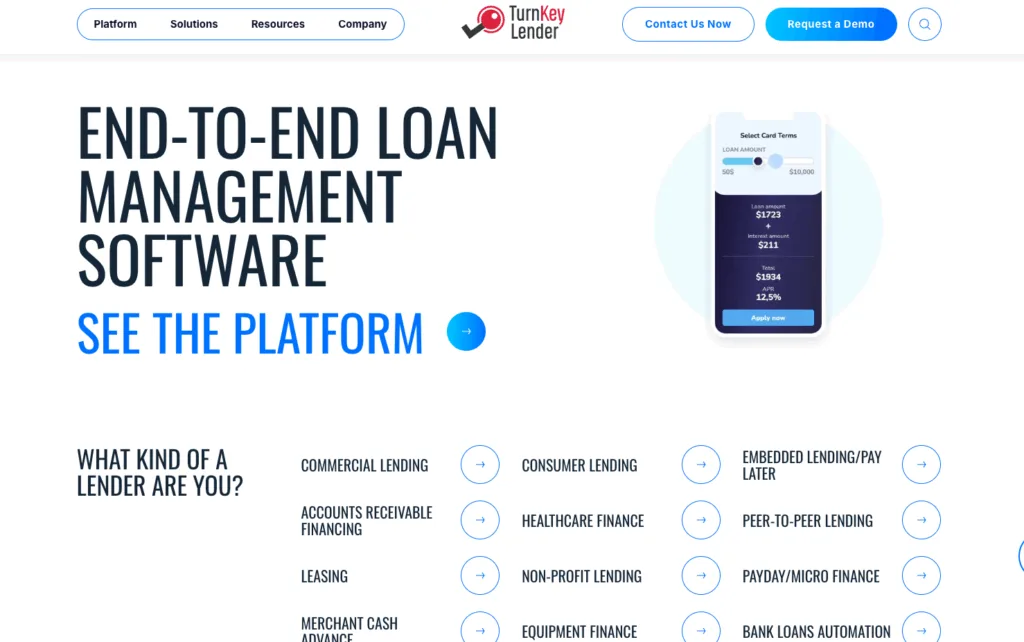
Best for: Non-profits needing fast deployment with AI-driven underwriting capabilities.
TurnKey Lender is an all-in-one platform offering origination and servicing with artificial intelligence features. The system deploys quickly with out-of-the-box configurations suitable for organizations wanting operational systems without lengthy implementations. AI-driven underwriting helps non-profits make faster credit decisions.
Ideal For:
- Small to mid-size non-profits
- Organizations without extensive IT resources
- CDFIs wanting AI assistance with underwriting
- Community lenders needing unified platforms
- Non-profits prioritizing speed-to-market
Core Features:
- Loan origination with configurable intake forms
- AI-powered underwriting analyzing credit risk
- Servicing module for payment processing and collections
- Document management with organized retrieval
- Reporting suite for portfolio analytics
Key Strengths:
Fast deployment gets organizations operational quickly with minimal configuration time. Out-of-the-box features reduce custom development costs for standard lending workflows. AI capabilities enhance underwriting accuracy beyond traditional rule-based systems. Cloud delivery enables remote access without on-premise infrastructure requirements.
Limitations:
Basic feature set compared to enterprise platforms may limit complex workflow needs. Less flexibility for highly customized lending programs beyond standard configurations. AI underwriting requires sufficient data for effective machine learning model training.
Pricing:
Contact TurnKey Lender for pricing based on organization size and lending volume.
7. The Mortgage Office
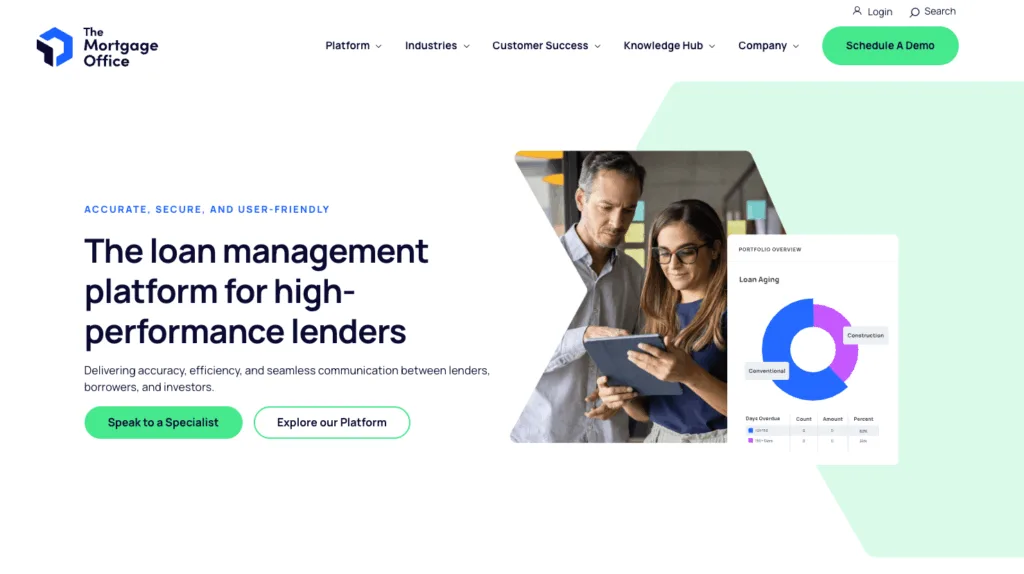
Best for: Non-profit housing lenders managing affordable mortgage and rehab loan portfolios.
The Mortgage Office is a mature platform used since the 1970s by non-profit and government lenders. The system offers comprehensive servicing for housing loans with sophisticated features like adjustable-rate management, investor tracking, and integrated accounting. Trusted by Habitat for Humanity, NeighborWorks, and municipal programs, TMO handles complex compliance requirements.
Ideal For:
- Community development loan funds managing housing portfolios
- Housing authorities administering rehab programs
- Tribal and faith-based lenders with housing missions
- Municipal governments managing community development lending
- Private non-profit lenders needing proven reliability
Core Features:
- Comprehensive loan tracking for charges, interest, and advances
- Multiple funding source assignment per loan
- Automated borrower billing via email or print
- Compliance tools for RESPA requirements and audit trails
- Accounting integrations with QuickBooks export
- Investor and fund management with reporting
Key Strengths:
Proven reliability with over 1,200 organizations demonstrates operational stability. Versatility handles large and small loans with specialized mortgage features. Bank-level security includes cloud backup and on-premise deployment options. Dedicated support understands non-profit housing finance and regulatory requirements.
Limitations:
Implementation effort requires time for extensive feature configuration and training. On-premise deployment option needs internal IT support, though cloud SaaS is available. A complex interface may feel dated compared to newer cloud-native platforms.
Pricing:
Available by quote only. Contact The Mortgage Office for custom pricing based on portfolio size.
8. Creatio CRM
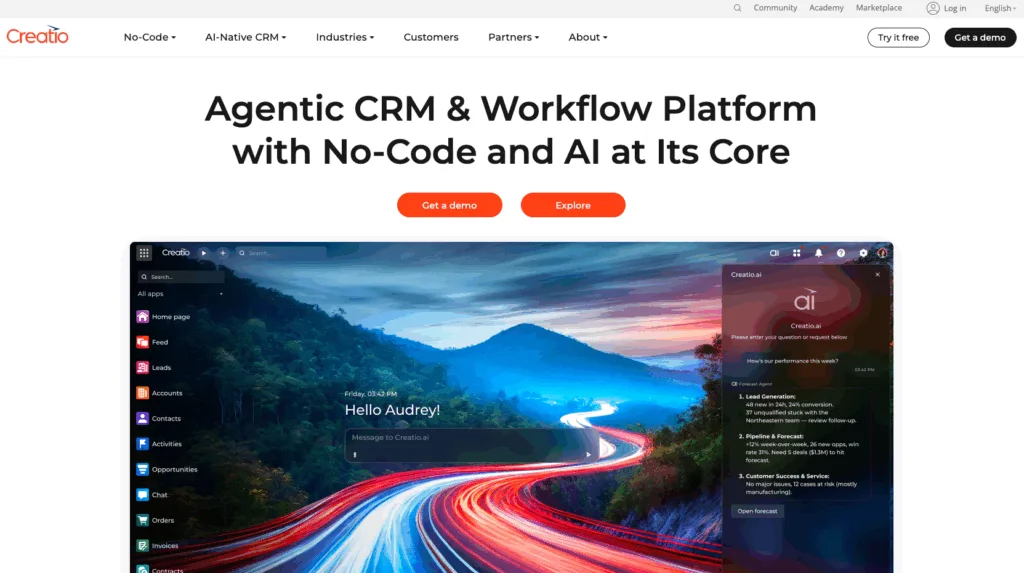
Best for: Non-profits wanting combined donor management and lending workflows in one platform.
Creatio is a workflow automation platform offering CRM capabilities for both donors and borrowers. The system enables organizations to manage fundraising activities alongside lending operations, providing unified constituent tracking. Flexible automation suits non-profits wanting customizable business process management.
Ideal For:
- Non-profits managing both lending and fundraising
- Community development organizations coordinating activities
- Faith-based lenders with relationship management needs
- Organizations prioritizing workflow automation
- Non-profits with limited technical resources
Core Features:
- Workflow automation for custom business processes
- Contact management for donors, borrowers, and partners
- Document management for loan and grant files
- Communication tools for email, phone, and meetings
- Reporting suite for lending and development analytics
Key Strengths:
Unified platform eliminates separate systems for lending and donor management activities. Workflow flexibility enables custom processes without extensive development resources. No-code configuration reduces implementation costs compared to custom development projects. Cloud delivery provides remote access without infrastructure investments.
Limitations:
Not purpose-built for lending, requiring configuration of loan-specific workflows. Less specialized features compared to dedicated loan management platforms. May require supplemental tools for complex servicing like payment processing.
Pricing:
Contact Creatio for pricing based on users and feature requirements.
Comparison Table: Best Non-Profit Loan Management Software (2026)
Selecting the right platform requires understanding how systems compare across deployment, strengths, and ideal use cases for non-profit lending operations.
| Platform | Best For | Deployment | Key Strengths |
| Nortridge | Non-profits, CDFIs, community lenders | SaaS or private cloud | Configurable workflows, 150+ reports, full lifecycle servicing |
| Fundingo | CDFIs on Salesforce | Cloud | Native CRM workflows, real-time dashboards, mission impact tracking |
| CDFIsolutions | Community lenders | Cloud | Purpose-built for CDFI missions, impact measurement, compliance tracking |
| LendingFront | Micro and SMB programs wanting fast deployment | Cloud | Fast deployment, online applications, automated underwriting |
| LoanPro | Non-profits with technical teams | Cloud | API-first architecture, extensive automation, custom integrations |
| TurnKey Lender | Small to mid-size non-profits | Cloud | AI-driven underwriting, fast deployment, out-of-the-box configuration |
| The Mortgage Office | Housing and mortgage non-profits | Web-based and on-premise | Proven mortgage servicing, affordable housing focus, investor management |
| Creatio | Non-profits needing CRM and lending | Cloud | Unified donor and borrower management, workflow automation |
How to Choose the Right Loan Management Software for a Non-Profit
Selecting the right loan management software requires evaluating your organization’s current operations, future growth plans, and technical capabilities against platform strengths and limitations.
1. Consider What Kinds of Loans You Manage
If your organization offers microloans, you need systems that handle small-dollar transactions efficiently. Mortgage-focused non-profits require specialized features like escrow management and ARM tracking. When you manage multiple loan products, look for platforms that support diverse loan structures without requiring separate systems for each program.
2. Evaluate Your Reporting Requirements for Grants and Funders
Your mission-driven organization must demonstrate impact through detailed portfolio analytics and borrower outcome tracking. If you manage multiple funding sources, you need systems that assign revenue and report by capital provider. Consider how your board reporting needs influence platform selection based on analytics capabilities available.
3. Project Your Lending Program’s Growth Over the Next 3-5 Years
Your growth plans determine whether lightweight tools suffice or enterprise platforms protect your investment. If you anticipate portfolio expansion, avoid systems requiring replacements as volume increases. Assess your scalability needs by considering both projected loan counts and product diversity over time.
4. Assess Your Integration and API Requirements
If your organization uses existing donor management systems, you benefit from platforms offering integration capabilities. When your technical team wants custom reporting, look for database access or API frameworks. Your integration needs influence whether turnkey solutions or API-driven platforms suit your operational requirements.
5. Determine How Important Audit Trail Precision is for Compliance Reviews
As a regulated lender, you require detailed tracking of all system changes and user activities. If your organization undergoes regular audits, prioritize platforms with comprehensive modification histories. Your compliance requirements determine acceptable levels of audit trail granularity needed.
6. Decide Whether You Need Both Origination and Servicing, or Just Servicing
Some non-profits manage origination through other systems, needing only servicing platforms. Full lifecycle management suits your organization if you want a unified application through payoff workflows. Servicing-only platforms like loan management software let you focus resources on portfolio management rather than origination features.
Match Your Non-Profit Lending Needs With the Right Software
The right loan management platform supports your mission, streamlines operations, and grows with your portfolio. Whether you need end-to-end lifecycle management for diverse community loan types, configurable workflows that adapt to your processes, or robust impact tracking and reporting tools, the platform you choose should help you overcome common loan servicing challenges through better automation and data visibility.
Nortridge Loan System is built for non-profit lenders and CDFIs who need flexibility, control, and powerful tools across the entire borrower lifecycle. Here’s what makes
Nortridge the configurable solution for mission-driven portfolios:
- Configurable workflows that mirror your lending programs
- 150+ standard reports with endless reporting possibilities
- Robust participation management for multiple funding sources
- U.S.-based support and consulting services
- 40+ years of experience managing $750B+ in active loans
- Flexible integration framework with extensive APIs
- Scalable architecture that grows with your portfolio
From configurable workflows to loan reporting and secure hosting, Nortridge supports any loan type and scales with your mission.
Schedule a demo today to see how Nortridge fits your non-profit lending operations.
Frequently Asked Questions
What is the best loan management software for non-profit lenders?
Nortridge excels for non-profits needing complete lifecycle management, extensive reporting, and flexible servicing tools supporting any loan type with configurable workflows and U.S.-based support.
What features should non-profits look for in loan management software?
Non-profits need configurable workflows, strong reporting for funders, secure hosting, borrower tracking tools, support for unique loan types, and understanding important features of loan management software.
Is CDFI loan servicing different from traditional loan servicing?
Yes, CDFI servicing requires flexible reporting for diverse funding sources, impact measurement tracking community outcomes, configurable workflows for mission-driven criteria, and multi-fund accounting capabilities.
Do non-profits need LOS + LMS or just servicing?
Many non-profits benefit from full origination and servicing setups. Organizations handling origination elsewhere may prefer servicing-only platforms. Consider your complete lending tech stack.