
10 Best Loan Management Software Systems in 2026

Choosing the best loan management software (LMS) can make or break your lending operations. The best platforms in 2026 give lenders and loan servicers more control, clearer data, and configurable workflows that reduce manual work across the entire borrower lifecycle.
This guide breaks down the best loan management software systems for 2026, what they offer, who they are commonly used by, and how they compare, so you can find a platform that fits your lending process, portfolio, and growth goals.
Table of Contents
- Quick Summary: Top Loan Management Software for 2026
- How We Evaluated the Best Loan Management Software for 2026
- 10 Best Loan Management Software Systems in 2026
- Comparison Table
- Finding the Best Loan Management Software for Your Lending Operations
- Frequently Asked Questions
Comparisons in this article are based on publicly available documentation, third-party reviews, and general product positioning. Descriptions of usability, flexibility, and fit reflect common use cases and user feedback rather than definitive assessments. Actual capabilities may vary by configuration and lender requirements.
Quick Summary: Top Loan Management Software for 2026
Here is a quick overview of the best loan management software platforms for 2026 and what makes each one stand out.
| Platform | Platform Focus |
| Nortridge Loan System | Configurable, full-lifecycle loan servicing across diverse and complex portfolios |
| TurnKey Lender | Combined origination and servicing with embedded AI-driven decisioning |
| LoanPro | API-first architecture for configurable, developer-led lending operations |
| Finastra Loan Servicing | Enterprise-scale loan servicing within a broader banking ecosystem |
| Defi Solutions | End-to-end auto and consumer lending lifecycle management |
| The Mortgage Office | Mortgage and real estate-backed loan servicing with investor reporting tools |
| Margill Loan Manager | Amortization-driven loan servicing with desktop and cloud deployment options |
| HES LoanBox | Modular digital lending platform with configurable origination and servicing |
| Liquid Logics (NOVA) | Real estate-focused lending workflows with draw and construction management tools |
| Bryt Software | Cloud-based loan servicing with streamlined setup for consumer and installment lending |
Platform summaries reflect vendor documentation and publicly available third-party reviews as of February 2026.
How We Evaluated the Best Loan Management Software for 2026
The best loan management software isn’t just about feature lists. It is about how well a system supports real-world lending operations, adapts to portfolio complexity, and scales as your organization grows.
For this guide, we reviewed publicly available vendor documentation, product positioning pages, and feature descriptions. We also analyzed aggregated user feedback from third-party review platforms such as Capterra, Gartner, Software Advice, and SoftwareWorld to identify common strengths and tradeoffs mentioned by users.
Evaluation criteria included:
- End-to-end borrower lifecycle support
- Configurable workflows
- Support for multiple loan types
- Dashboards and reporting capabilities
- Hosting and deployment options
- API capabilities and integration flexibility
- Document tracking and audit trails
- Servicing and collections tools
- Pricing structure transparency
All information reflects publicly documented materials accessed in February 2026. Platform capabilities, pricing, and positioning may vary by configuration or deployment.
10 Best Loan Management Software in 2026
The loan management software landscape in 2026 offers more choices than ever. The best platform depends on your portfolio complexity, loan types, and servicing requirements. This guide compares 10 leading systems across features, pricing, strengths, and positioning to help you find the right fit.
1. Nortridge Loan System

Platform Focus: Configurable, full-lifecycle loan servicing designed to support complex and diverse lending portfolios.
Nortridge Loan System is a configurable loan servicing platform built for lenders and loan servicers that require end-to-end lifecycle control, powerful workflow automation, and the flexibility to support multiple loan types within a single system. Nortridge integrates with leading loan origination systems (LOS) to maintain continuity from origination through servicing and collections.
Industries Served:
- Consumer lending
- Auto finance
- Commercial lending
- CDFIs and nonprofit lenders
- Mortgage and real estate-backed lending
Explore all industries Nortridge serves to see how the platform adapts to different portfolio types and operational models.
Core Features:
- Configurable workflows for servicing, payments, and collections
- Loan reporting software and dashboards (150+ reports)
- Document tracking and audit trails
- Payment processing (ACH, card, cash via supported partners)
- API framework for integrations
- Borrower communications tools
- Support for any loan type (consumer, auto, commercial, CDFI, timeshare, medical, student, mortgage, and more)
- SaaS or private cloud hosting with enterprise security
View the full list of Nortridge features to explore the complete platform functionality.
Key Strengths:
- Highly configurable platform adaptable to diverse loan structures
- Designed for complex, high-volume servicing environments
- Deep reporting and portfolio visibility
- U.S.-based implementation and support team
- 40+ years in the lending software industry
- $750B+ in active loans managed across client portfolios
Considerations:
- Investor marketplace functionality is not native to the platform
- Compliance monitoring remains the responsibility of the lender
Pricing:
Nortridge SaaS pricing starts at $1,200/month. Enterprise licensing is available for high loan volume lenders. Contact Nortridge for a customized quote.
2. TurnKey Lender

Platform Focus: Cloud-based, end-to-end lending platform combining origination, underwriting, servicing, and collections with AI-driven automation.
TurnKey Lender is positioned as an all-in-one lending system that unifies origination, underwriting, servicing, and collections within a single cloud-based environment. The platform emphasizes automation through proprietary AI technology and preconfigured integrations designed to streamline implementation and reduce manual workflows.
Industries Served:
- Consumer lending operations
- Commercial lending (B2B lending)
- Buy Now Pay Later (BNPL) providers
- Payday loan operations
- Equipment finance
Industries listed reflect examples publicly highlighted by TurnKey Lender and may vary by deployment.
Core Features:
- Loan origination with configurable application flows and terms management
- AI-powered credit scoring and underwriting with automated decisioning
- Loan servicing with automatic payment processing and statement generation
- Debt collections with delinquent account tracking
- Configurable reporting and analytics for portfolio insights
The features above represent a summary of publicly documented capabilities and do not encompass the full scope of TurnKey Lender’s functionality.
For a direct side-by-side comparison, see Nortridge vs. TurnKey Lender.
Key Strengths:
(Based on vendor materials and aggregated third-party reviews accessed February 2026)
- AI and machine learning decisioning capabilities for automated approvals
- All-in-one platform combining origination, servicing, and collections
- Configurable loan application processes and onboarding workflows
Considerations:
(Based on vendor documentation and publicly available positioning)
- Implementation timelines vary depending on integration scope and configuration depth
- Deployments with significant customization may require additional upgrade planning
Pricing:
Pricing not publicly available. Contact vendor for details.
3. LoanPro
BePlatform Focus: API-first, cloud-native loan servicing platform designed for lenders prioritizing automation and technical flexibility.
LoanPro is positioned as a modern, API-driven lending platform supporting loan servicing, payments, and collections across multiple lending verticals. The system emphasizes deep configurability, automated workflows, and integration flexibility as alternatives to traditional legacy servicing environments.
Industries Served:
- Financial institutions
- Consumer lending operations
- Business lending (commercial finance)
- Auto lending and auto finance
- Neobanks and digital lenders
Industries listed reflect examples publicly highlighted by LoanPro and may vary by deployment.
Core Features:
- Configurable servicing workflows through API-first architecture
- Borrower self-service portal for account management
- Automated communications and borrower notifications
- Reporting tools supporting operational needs
- Integration framework built for custom system connectivity
The features above represent a summary of publicly documented capabilities and do not encompass the full scope of LoanPro’s functionality.
For a detailed comparison, see Nortridge vs. LoanPro.
Key Strengths:
(Based on vendor materials and aggregated third-party reviews accessed February 2026)
- API-first architecture supporting extensive configurability
- Cloud-native infrastructure built on AWS
- Unified servicing and automation environment
- Frequently cited for flexibility and integration capabilities
Considerations:
(Based on vendor documentation and publicly available positioning)
- API-driven architecture may require internal technical resources to fully leverage
- Implementation scope varies depending on integration complexity
Pricing:
Pricing not publicly available. LoanPro provides custom quotes based on account volume, program complexity, and service requirements.
4. Finastra Loan Servicing
Platform Focus: Enterprise-grade loan servicing platform designed for syndicated, commercial, and corporate lending environments.
Finastra’s Loan IQ platform is positioned for large financial institutions managing complex commercial and syndicated loan portfolios. Vendor materials highlight broad adoption among global banks and emphasize the system’s ability to consolidate multiple corporate lending workflows within a single servicing environment.
Industries Served:
- Global agent banks
- Commercial lending institutions
- Syndicated lending programs
- SME (Small and Medium Enterprise) lending
- Bilateral loan servicing operations
Industries listed reflect examples publicly highlighted by Finastra and may vary by deployment.
Core Features:
- Syndicated and commercial loan servicing workflows
- Risk management and credit administration tools
- Document management and real-time portfolio reporting
- Integrated origination and processing capabilities
- Payment processing and lifecycle tracking
- CRM and financial system integrations
The features above represent a summary of publicly documented capabilities and do not encompass the full scope of Finastra’s functionality.
Key Strengths:
(Based on vendor materials and aggregated third-party reviews accessed February 2026)
- Widely adopted within global syndicated lending markets
- Positioned for complex, institution-scale commercial portfolios
- Consolidates multiple corporate banking loan types within a unified platform
- Enterprise-focused servicing architecture
Considerations:
(Based on vendor documentation and publicly available positioning)
- Primarily designed for institution-scale deployments
- Implementation complexity and integration scope vary by institutional requirements
Pricing:
Pricing not publicly available. Finastra provides enterprise-level custom quotes based on institution size, deployment scope, and product configuration.
5. Defi Solutions
Platform Focus: Auto and consumer finance loan servicing platform designed for banks, credit unions, and finance companies managing vehicle-backed and installment portfolios.
defi SOLUTIONS provides SaaS-based loan servicing software supporting both auto and consumer finance operations. The platform emphasizes workflow automation, account and collateral management, and digital borrower engagement within an API-enabled architecture designed to integrate with external systems.
Industries Served:
- Banks offering auto lending
- Credit unions with auto portfolios
- Finance companies
- Captive auto lenders
- Auto lease servicers
Industries listed reflect examples publicly highlighted by defi SOLUTIONS and may vary by deployment.
Core Features:
- Account management, including invoicing, payment processing, cash management, and credit bureau reporting
- Collateral management for titles, leases, balloon payments, and vehicle remarketing
- Default and collections management with rules-based queuing
- Digital borrower portal for payments and self-service actions
- Workflow automation across servicing operations
The features above represent a summary of publicly documented capabilities and do not encompass the full scope of defi SOLUTIONS’ functionality.
Key Strengths:
(Based on vendor materials and aggregated third-party reviews accessed February 2026)
- Platform built specifically for auto loan and lease servicing
- API-enabled architecture supporting external integrations
- Configurable SaaS deployment model
- Automation capabilities across account and collections workflows
- Long-standing presence in the auto finance market
Considerations:
(Based on vendor documentation and publicly available positioning)
- Primarily built around auto and consumer finance workflows
- Implementation scope varies depending on integration and servicing complexity
Pricing:
Pricing not publicly available. Contact vendor for details.
6. The Mortgage Office
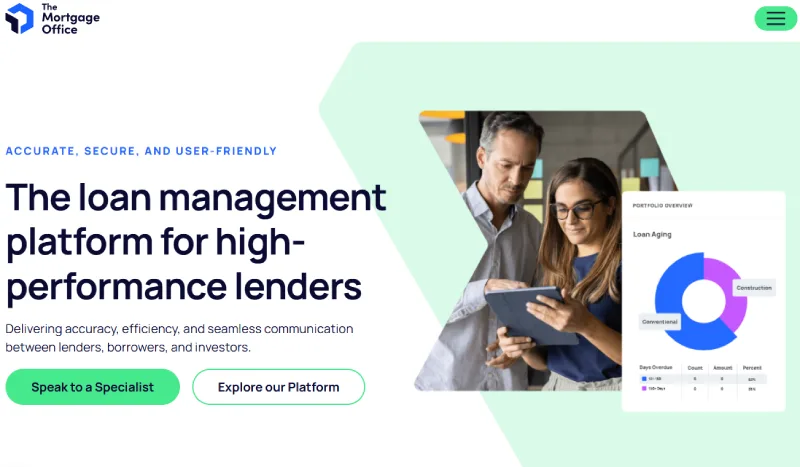
Best Platform Focus: Loan origination, servicing, and fund management platform designed for private and real estate-backed lending environments.
The Mortgage Office (TMO) provides loan management software supporting origination, servicing, and investor fund management. The platform is positioned for private lenders, municipalities, nonprofits, and educational institutions seeking detailed accounting accuracy and investor reporting tools.
Industries Served:
- Private lenders
- Municipalities and government entities
- Non-profit organizations
- Educational institutions
Industries listed reflect examples publicly highlighted by The Mortgage Office and may vary by deployment.
Core Features:
- Automated payment processing with configurable fee calculations and allocation logic
- Borrower and investor portals for self-service access and reporting transparency
- Fund management tools with waterfall calculations and automated investor distributions
- Real-time portfolio analytics and reporting
- QuickBooks integration with property tax and insurance tracking
The features above represent a summary of publicly documented capabilities and do not encompass the full scope of The Mortgage Office’s functionality.
Key Strengths:
(Based on vendor materials and aggregated third-party reviews accessed February 2026)
- Long-standing presence in private lending markets
- Broad adoption across real estate and fund-backed lending operations
- Investor reporting and fund management capabilities
- SOC 2 certified cloud infrastructure
- Frequently cited in reviews for responsive customer support
Considerations:
(Based on vendor documentation and publicly available positioning)
- Primarily designed for private and real estate-backed lending workflows
- Pricing varies by modules and deployment
Pricing:
Pricing not publicly available. Contact vendor for details.
7. Margill Loan Manager
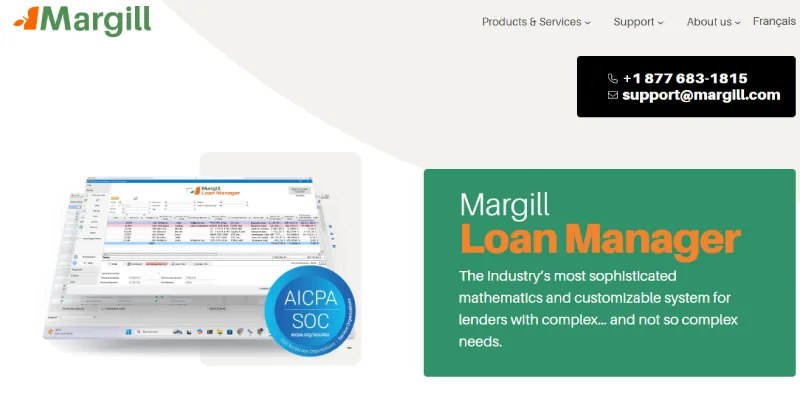
Platform Focus: Loan servicing software emphasizing advanced interest calculations and amortization flexibility across diverse loan types.
Margill Loan Manager provides loan servicing software supporting consumer, business, construction, intercompany, and line-of-credit lending. The platform emphasizes sophisticated interest mathematics, flexible amortization structures, and options for organizations managing complex payment scenarios. Vendor materials highlight usage across multiple industries with deployment options including both cloud and self-hosted environments.
Industries Served:
- Law firms and legal professionals
- Government entities and municipalities
- Banks and financial institutions
- Community and economic development lenders
- Accountants and accounting firms
- Corporations managing employee and intercompany loans
- Construction and land development companies
Industries listed reflect examples publicly highlighted by Margill and may vary by deployment.
Core Features:
- Advanced amortization schedules supporting regular, irregular, and interest-only structures
- Configurable interest calculation engine with variable rate support
- Configurable reports, dashboards, and payment structures
- Accounting integrations with platforms such as QuickBooks and Sage
- Payment tracking, customer reminders, and electronic fund transfer capabilities
The features above represent a summary of publicly documented capabilities and do not encompass the full scope of Margill Loan Manager’s functionality.
Key Strengths:
(Based on vendor materials and aggregated third-party reviews accessed February 2026)
- Strong focus on detailed amortization and interest calculation accuracy
- Flexible configuration without heavy reliance on vendor development
- Deployment options including self-hosted and SaaS models
- Frequently cited in reviews for responsiveness and support quality
Considerations:
(Based on vendor documentation and publicly available positioning)
- Deployment and licensing structures differ between self-hosted and cloud options
- Advanced report configuration may require initial setup time
Pricing:
Pricing not publicly available. Contact vendor for details.
8. HES LoanBox
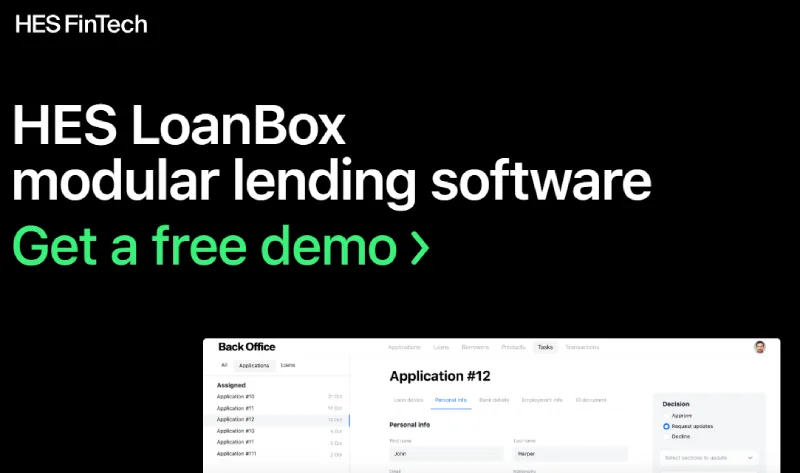
Platform Focus: Modular, AI-enabled lending platform designed for digital-first lenders seeking configurable origination and servicing workflows.
HES LoanBox provides an end-to-end lending platform covering origination, underwriting, servicing, and collections within a modular architecture. The platform emphasizes AI-driven automation, configurable loan product setup, and relatively fast deployment timelines. Vendor materials highlight international project experience and certifications aligned with security standards.
Industries Served:
- Banks and financial institutions
- Alternative and digital lenders
- Fintech companies
- Consumer lending operations
- Commercial and SME lenders
- Auto finance and BNPL providers
Industries listed reflect examples publicly highlighted by HES LoanBox and may vary by deployment.
Core Features:
- AI-powered underwriting and credit decisioning
- Modular deployment across origination, servicing, and collections
- Configurable loan product creation and workflow automation
- Borrower portal with digital onboarding and verification tools
- Dashboards and reporting with configurable exports
The features above represent a summary of publicly documented capabilities and do not encompass the full scope of HES LoanBox’s functionality.
Key Strengths:
(Based on vendor materials and aggregated third-party reviews accessed February 2026)
- Modular architecture allowing phased or full-lifecycle implementation
- Strong emphasis on automation and AI-driven decisioning
- International project footprint across multiple jurisdictions
- Security certifications including ISO 27001
- Frequently cited in reviews for configuration flexibility
Considerations:
(Based on vendor documentation and publicly available positioning)
- Modular deployment requires planning around integration scope
- Implementation timelines vary depending on configuration and requirements
Pricing:
Pricing not publicly available. Contact vendor for details.
9. Liquid Logics (NOVA)
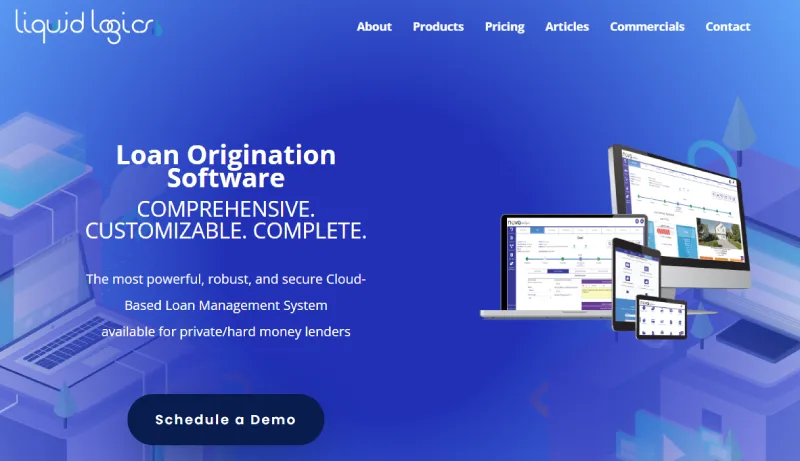
Platform Focus: Cloud-based lending platform designed for private and real estate-backed lending workflows.
Liquid Logics offers NOVA, a cloud-based loan management platform built for private lenders and real estate-backed loan programs. The system supports origination, servicing, fund management, and construction draw workflows within a unified environment. Vendor materials emphasize automation, borrower experience, and configurable workflows tailored to hard money and residential investment lending.
Industries Served:
- Private lenders
- Hard money lenders
- Residential mortgage lenders
- Real estate investment lenders
- Fix-and-flip and bridge loan lenders
Industries listed reflect examples publicly highlighted by Liquid Logics and may vary by deployment.
Core Features:
- Loan origination workflows with configurable pipelines and processing stages
- Servicing tools including payment tracking, autopay, and monthly statements
- Borrower portal for document uploads and account management
- Fund management tools supporting investor reporting and distributions
- Construction draw and inspector portal functionality
The features above represent a summary of publicly documented capabilities and do not encompass the full scope of Liquid Logics NOVA’s functionality.
Key Strengths:
(Based on vendor materials and aggregated third-party reviews accessed February 2026)
- Built specifically for private and real estate-backed lending models
- Unified platform covering origination, servicing, and fund management
- Cloud-based SaaS deployment with configurable branding
- Strong emphasis on borrower and broker portal experience
- Established presence in private lending markets
Considerations:
(Based on vendor documentation and publicly available positioning)
- Primarily built for real estate-secured and private lending workflows
- Implementation scope depends on desired modules and configuration depth
Pricing:
Pricing not publicly available. Contact vendor for details.
10. Bryt Software
BPlatform Focus: Cloud-based loan servicing platform designed for lenders seeking streamlined workflows and simplified deployment.
Bryt Software provides loan servicing tools focused on payment tracking, borrower communication, reporting, and workflow automation. The platform emphasizes ease of use, cloud-based deployment, and support resources aimed at growing lending operations across multiple verticals.
Industries Served:
- Banks and neobanks
- CDFIs and non-profit organizations
- Consumer and private lending operations
- Commercial and mortgage lenders
- Construction loan servicers
- Automotive finance lenders
- Healthcare and education lenders
Industries listed reflect examples publicly highlighted by Bryt Software and may vary by deployment.
Core Features:
- Loan servicing tools for payment tracking, delinquency monitoring, and fee application
- Built-in CRM functionality for borrower communication
- Automated payment waterfall and interest calculation
- Standard and configurable reporting templates
- Workflow automation for notices, reminders, and document management
The features above represent a summary of publicly documented capabilities and do not encompass the full scope of Bryt Software’s functionality.
Key Strengths:
(Based on vendor materials and aggregated third-party reviews accessed February 2026)
- Cloud-native deployment with secure hosting infrastructure
- Emphasis on ease of use and straightforward onboarding
- Support resources frequently cited positively in reviews
- Flexible plan tiers supporting different lender sizes
Considerations:
(Based on vendor documentation and publicly available positioning)
- Configuration depth and feature availability vary by plan tier
- Advanced workflow setup may require planning during initial implementation
Pricing:
Business version starts at $89/month. Professional version starts at $160/month. Pricing per vendor website, February 2026.
Comparison Table: Best Loan Management Software
Compare leading loan management software platforms by supported loan types, notable capabilities, and pricing structure. Information reflects publicly available vendor materials accessed in February 2026.
| Platform | Loan Types Highlighted | Notable Capabilities | Pricing |
| Nortridge | Consumer, auto, commercial, hard money, mortgage, CDFI, medical, student, timeshare | Highly configurable servicing workflows, 150+ reports, built-in collections tools, robust API framework, SaaS or private cloud deployment, 40+ years in business | Starts at $1,200/mo |
| TurnKey Lender | Consumer, commercial, BNPL, payday, equipment finance | AI-driven underwriting, end-to-end origination through servicing, automation-focused deployment | Contact vendor |
| LoanPro | Consumer, business, auto | API-first architecture, cloud-native infrastructure (AWS), automation tools, developer-focused configuration | Contact vendor |
| Finastra Loan Servicing | Syndicated, commercial, corporate, SME, bilateral loans | Enterprise-scale syndicated loan servicing, consolidated commercial lending workflows | Contact vendor |
| Defi Solutions | Auto loans, auto leases, vehicle-backed lending | Auto finance specialization, collateral and title management, digital borrower portal, SaaS deployment with API integrations | Contact vendor |
| The Mortgage Office | Private lending, real estate-backed loans, mortgages, bridge loans, construction loans | Investor fund management tools, borrower and investor portals, mortgage-focused servicing workflows | Contact vendor |
| Margill Loan Manager | Consumer, business, intercompany, employee, construction, lines of credit, mortgages, leases | Advanced amortization engine, flexible interest calculations, self-hosted or cloud deployment | Contact vendor |
| HES LoanBox | Consumer, commercial, SME, auto, BNPL, microfinance, student, healthcare, mortgage | Modular platform, AI-based credit decisioning, configurable workflows, ISO 27001 certified | Contact vendor |
| Liquid Logics (NOVA) | Private lending, hard money, residential mortgage, fix-and-flip, bridge loans, construction loans | Loan origination and servicing, construction draw management, borrower portals, private lending focus | Contact vendor |
| Bryt Software | Consumer, private, commercial, mortgage, construction, automotive, healthcare, education | Cloud-native servicing, automated workflows, CRM tools, tiered pricing model | Starts at $89/mo |
Platform summaries reflect vendor documentation and publicly available third-party reviews as of February 2026.
Finding the Best Loan Management Software for Your Lending Operations
The best loan management software reduces manual work, provides configurable workflows, and scales with your business. Whether managing consumer loans, commercial portfolios, or specialized lending programs, the best platform gives you control without forcing rigid limitations.
Nortridge supports loan servicers across any loan type with configurable workflows, extensive reporting, and U.S.-based support backed by 40+ years of experience.
Schedule a demo to see how Nortridge fits your lending needs.
Frequently Asked Questions
What is loan management software?
What is the difference between loan servicing software and loan origination software?
For a deeper breakdown of how these systems differ and when you may need one or both, see our guide on loan origination vs. loan servicing.